I had breakfast with a friend of mine yesterday. It turns out we have both recently purchased hybrids. She moved from a Yukon to a Highlander hybrid. I went from a 3-series BMW to a Prius.
I drove away thinking about our hybrids. She was a bit disappointed with her Highlander's mileage, but it occurred to me that by moving from the Yukon to the Highlander, she reduced carbon emissions by twice the amount that I did by moving from my Beamer to the Prius. These numbers are guesstimates, but let's imagine that we each drive 12,000 miles per year, and that she went from 12 to 24 mpg (actually, I think she's getting more like 28), and I went from 24 to 48 mpg (that's actually pretty close). Those numbers are close enough for illustration, and easy to calculate with. I also found (from here) that 1 gallon of gasoline produces 19.4 pounds of CO2, a pretty amazing number. (Only 5.3 pounds are carbon, the rest is oxygen.)
The Yukon used 1000 gallons a year, producing 19,400 pounds of CO2.
The Highlander (and my Beamer) uses 500 gallons a year, producing 9,700 pounds of CO2.
My Prius uses 250 gallons a year, producing 4,850 pounds of CO2.
So she is saving 9,700 pounds of CO2, while I have only saved 4,850 pounds.
This isn't a trick. It's because the Yukon was using a lot more to start with. But it was illuminating to me. It highlights the disproportionate impact that gas hogs have. And it points out how moving from an inefficient SUV to a more efficient SUV reduces carbon emissions (and fuel consumption) by twice as much relative to the sedan-to-sedan improvement.
Hence the inflammatory title.
Of course, the biggest impact would be to go from Yukon to Prius. But it's interesting how the apparently smaller 12-to-24 change has double the impact of the apparently larger 24-to-48 change. It's all real and explainable, but counter intuitive to a lot of consumers.
Wednesday, December 20, 2006

Thursday, December 14, 2006
Trust versus corruption
I've been spending my active time working on scaling up my favorite project, as you all know. But my less active energy (i.e. thinking, pondering, puzzling) is spent on two topics: Trust and Corruption.
Corruption came up at the tail end of reading William Easterly's "The Elusive Quest for Growth". Sure, we all know about it, but the impact on development is so big that it should dominate any policy discussion. There are sites, like Transparency.org and others, that spend their existence on the problem. A major issue is that no one has found a surefire way to eradicate corruption. Corruption has a corrosive effect on aid as well, since it impacts confidence that aid will go where it's intended.
By contrast, the hands-on development assistance delivered by small NGOs doesn't have nearly as much leakage. Much of my enthusiasm for Appropedia is due to my desire to crank up this approach to aid delivery, in part to increase the person-to-person contact between the developed and developing worlds. As I read about the challenge of corruption, I got even more motivated to promote small NGO aid delivery.
Now, as it happens I'm pretty much a greenhorn when it comes to delivering aid (though I hope to change that over time). So I knew I needed to connect with experienced people to see how the world really works, so that I could do the right things to scale the impact. Repeatedly, the key component to making a small NGO-to-community engagement work in the developing world is...trust. You must have a trusted man-or-woman-on-the-ground. It could be an expat, but those are fairly uncommon, so doesn't address the "scaling issue". So that means it will probably be a local. And you'll need to trust them. And they will need to trust you.
As I've been considering this conundrum, I came across Aaron's post, and had to laugh. Yep, that captures a piece of the problem! Sure, most of us in the developed world have probably seen (and perhaps even touched!) skin that's a different color than our own. And though there are bigger barriers than the visual differences, it's a great nutshell story for the magnitude of the gap.
So how do we bridge this trust gap, and (mostly) bypass corruption to deliver aid and build relationships? Ah, well, that's the puzzle.
My ideas for solutions include:
Trust me.
(Or maybe you think this post is a counter example? :-)
Corruption came up at the tail end of reading William Easterly's "The Elusive Quest for Growth". Sure, we all know about it, but the impact on development is so big that it should dominate any policy discussion. There are sites, like Transparency.org and others, that spend their existence on the problem. A major issue is that no one has found a surefire way to eradicate corruption. Corruption has a corrosive effect on aid as well, since it impacts confidence that aid will go where it's intended.
By contrast, the hands-on development assistance delivered by small NGOs doesn't have nearly as much leakage. Much of my enthusiasm for Appropedia is due to my desire to crank up this approach to aid delivery, in part to increase the person-to-person contact between the developed and developing worlds. As I read about the challenge of corruption, I got even more motivated to promote small NGO aid delivery.
Now, as it happens I'm pretty much a greenhorn when it comes to delivering aid (though I hope to change that over time). So I knew I needed to connect with experienced people to see how the world really works, so that I could do the right things to scale the impact. Repeatedly, the key component to making a small NGO-to-community engagement work in the developing world is...trust. You must have a trusted man-or-woman-on-the-ground. It could be an expat, but those are fairly uncommon, so doesn't address the "scaling issue". So that means it will probably be a local. And you'll need to trust them. And they will need to trust you.
As I've been considering this conundrum, I came across Aaron's post, and had to laugh. Yep, that captures a piece of the problem! Sure, most of us in the developed world have probably seen (and perhaps even touched!) skin that's a different color than our own. And though there are bigger barriers than the visual differences, it's a great nutshell story for the magnitude of the gap.
So how do we bridge this trust gap, and (mostly) bypass corruption to deliver aid and build relationships? Ah, well, that's the puzzle.
My ideas for solutions include:
- Changing the way we vacation in the third world, so that we don't rush past all the faces but find some way to stop and bond with at least a small number of real people for several hours. That by itself is important. Translation will probably be necessary. Locals that already speak a foreign language have probably bonded a lot and are somewhat westernized. Get them to connect you to someone who doesn't speak a foreign language.
- Revive the "pen pal" notion to grow a relationship with someone you met while traveling. This could be challenging, given the translation thought...but there are now some amazing free translation tools on the web. Email pen pals require connectivity, though. So maybe your travel plans are part of an Inveneo project :-). Or perhaps it really does make sense to work on a deeper relationship with a local who speaks your language. This might lead to...
- Looking for ways to support "exchange students", or just visitors, from the developing world for a few weeks in the rich world. It's hard for me to imagine someone sponsoring a visitor unless there have been quite a bit of contact (a la pen pal) over time. And I have no sense for the US visa challenges involved.
Trust me.
(Or maybe you think this post is a counter example? :-)
Sunday, December 3, 2006
Burnin' it up
Wow, that was fast.
I kinda new it had been a while since I posted. No shortage of things to say, just... Well, y'know... Time.
But still staggering to look at the date of the last post and find that over two weeks have passed.
Anyway, just a temporary lapse. One of many, sure, but anyway I'm back. Once again a busy week at Lake Wobegon. There was Thanksgiving, of course, and it was one of the good ones. Won't go into that, though. In addition, I've met with several people, gone to another EWB-SFP meeting, where they had a great presentation by their Appropriate Technology Design Team (ATDT), including a great presentation by Ken on the Darfur Cookstove project.
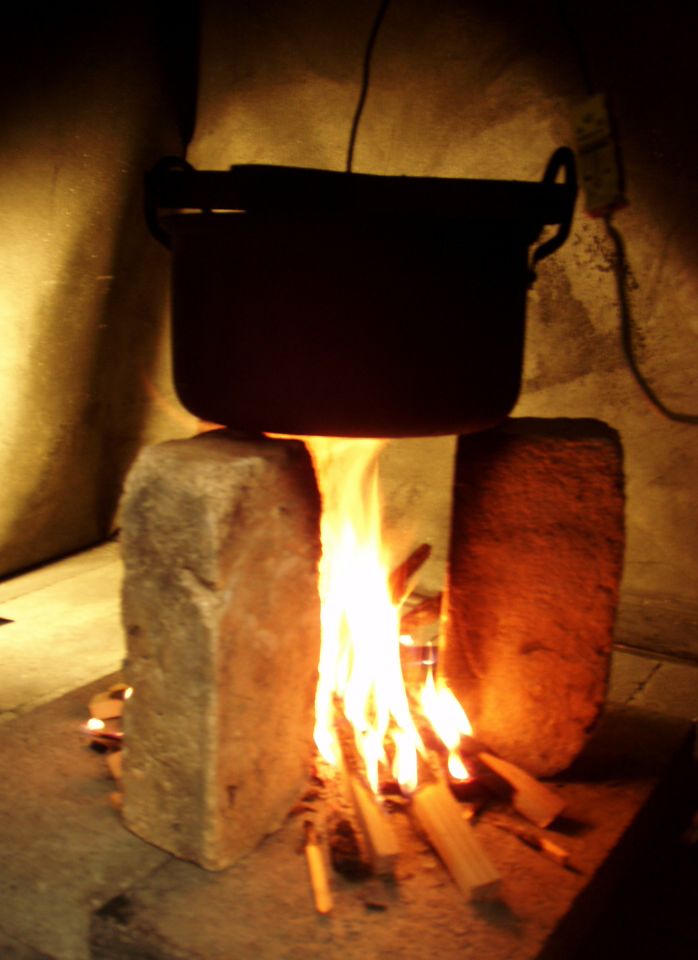
That one was particularly educational. Here are the highlights. There are about 2.2 million "IDP's" (internally displaced persons, considered distinct from refugees) in Darfur. Nearly all of them cook using the traditional "3 rock stove" technique (see photo, from ATDT Aprovecho blog post), which does not make very efficient use of fuel (i.e. firewood). Food is supplied by international aid. Fuel is supplied by gathering for nearby...except that over time the local area has been denuded of wood, and so now "nearby" means a 7 hour round trip to collect wood. Women and children perform the gathering, under threat of rape or mutilation. It's worse if men do it; the likelihood of murder is quite high. So there is value in reducing the need for collecting firewood. Solar cookers have been developed, but unfortunately the nature of the cookers does not allow for cooking of the traditional meals, and so the IDP's, desparate for a vestige of their lost lives, revert to the cooking they know, and the solar cookers have not been adopted.
ATDT got involved. They took a look at some existing FES's (fuel efficient stoves, yes it even gets its own acronym!) and found that, like the solar cookers, you could not cook the traditional meals. They also were very sensitive to wind, which tends to blow at around 6 mph in Darfur. They also wanted to develop a design for a stove that could be manufacture at a reasonable cost in Darfur itself! (It's hard, but there are lots of benefits to this.) So they made some tweaks and improvements, and have a version that looks very promising, using 1/4 of the fuel of the tradition scheme. This can make a huge difference, especially if the stoves can be made locally. Currently 50 proto stoves are undergoing testing by IDP's on site in Darfur. (Amazingly, this and other aid efforts have been hampered by travel restrictions imposed by the government in Khartoum. Apparently Nicholas Kristof's articles do not exagerate.)
Much of this (including some cool photos) is captured in the ATDT stove test blog post (this is a different post from the one referenced above). When I read this (ages ago), I noticed a comment that had been left. The comment poster essentially said "yeah, but what's this got to do with reality?" This was pretty much my reaction when I read the blog; I thought, well great, they've inched up efficiency another 3%, but airlifting 300,000 stoves to Darfur seems like the wrong priority of investment, and I figured solar cookers would make more sense. I was mistaken; everything was illuminated at the EWB-SFP meeting last week. I'm extremely impressed with the effort to engage the local IDP's in manufacturing, using materials and tools and skills available in Sudan. And there's more. They're even finding clever ways to fund this, such as a form of carbon credits, since the new stove reduce the amount of carbon released into the atmosphere by several tons over the life of the stove. Wow.
I also met with Marc, the director of The Clarence Foundation, which is doing some great work on giving circles, including a "traveling giving circle" which will make some decisions in Nairobi early next year (there's still room, I think). I'm very excited by that, and will be joining up in the new year. Also contacted Robin, who is working to improve the lives of villagers near Kilimanjaro via Hope Through Opportunity, as well as Natalie, who recently visited west Africa and wants to help make an impact on education there. Several people have been joining the effort at my favorite wiki, where page views have been skyrocketing, probably as a result of some promotional work, as well as some very successful porting efforts. (Plus, of course, it's just a damn great idea.) We've been porting (with permission, of course) some great material from the Erssons, Practical Action, International Rivers Network (along with American Rivers), and G.P.Baron of Philippine BioDigesters (really). Numerous other contributors are creating some original content as well.
And in the coming week I'm gonna be meeting with Doug, and John, and Ken and...
But I promise to write a post...though it could be a 2 liner. (Did I hear someone say "Is that a threat or a promise?")
Saturday, November 18, 2006
Who will change the world?
If you're hopeful about the world's prospects, are you a positivist? Or naive? If you're negative, are you a cynic? Or does that perspective come from the wisdom of experience? I've been asking myself these questions, because I'm not a spring chicken, but still tend to see the world in terms of what can happen, what can be achieved, what things could be like. I tend to see the rest of humanity as having wants and desires and, in many ways, similar values to mine. We want safety, opportunity, good health, basic resources and a fair bit of freedom. We'll make some sacrifices in some areas in exchange for gains in other areas. We would like our children to have good lives, better than ours if possible, but certainly not worse.
Well, I'm lucky to have most of the things I want. The future, where my children will live, is harder to assess, of course, and there are certainly causes for concern. I would like to improve their prospects, if I can. And then there's the 5.5 billion or so folks whose situations are much worse than mine, and whose children are in desperate need. I would like to do something to make their lives better as well. I've wanted that at some level for years, but haven't done much about it. More recently, I've become a little more active. The tricky bit is that, coming from an engineering background, I have a strong bias toward the real world. And yet, it's often very hard to see any clear, quantitative benefit from the efforts I make. Have I gone off the deep end? Am I now a hopelessly hopeful idealist?
Well, I had to think about this. Here's the thing: If you've got a positive attitude, does that make you unrealistic? Are you a realist if you think we're doomed? If that's the case, then maybe we are doomed!
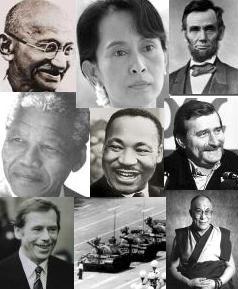
So I thought about those that had a positive impact on the world. I'm talking about people in the blog logo in the upper right. Lincoln, King, Gandhi. Toss in JFK and Roosevelt and maybe Mother Teresa and Albert Schweizer. Even Jesus and Buddha. Where do they fall in the spectrum?
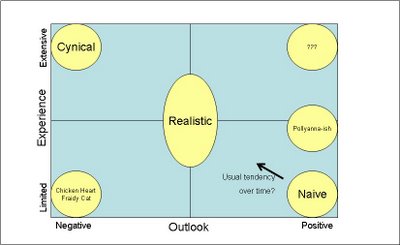
After chewing on this for, well, weeks actually, at some point it clicked for me that there are two dimensions involved: outlook and experience. Most of us start out with a positive outlook and no experience. We're optimistic and idealistic, though someone in our lives may step in to save us from being too gullible. As we grow in experience, we tend to become less positive, even pessimistic, jaded, or cynical over time. It's sad, but some of us actually start out negative and doubtful, and that's definitely a bummer, because I don't think experience will tend to make most people a lot more positive. But let's go back to who makes a difference.
So, going back to the worldchangers: I see them all as positive. But not in a weak way. Instead, I see these folks as being faithful. They had or have faith in humanity's ability to overcome our own weaknesses. And we have people like that still. We have Jimmy Carter, Paul Farmer and Jeffrey Sachs. And hundreds more who are savvy, experience, been through the trenches and yet continue to advocate for positive change. They fit into the upper right of the chart I included. That's where you've got to be if you expect to make positive change!
There are also numerous celebreties, like Bono, Madonna, Angenlina Jolie, etc, who advocate for change, but who may not have the pedigree of experience and who therefore tend to be dismissed as idealists. Funny, isn't it, how a weathered and tested soul can express an opinion and be respected and lauded, but when a young and idealistic person expresses a similar view, they're naive and idealistic? I'm in a similar boat: Older than Angelina, but about the same age as Madonna and Bono, I don't really have much experience in a third world life style, though my mother raised 5 kids solo with the help of AFDC checks. So, if I have positive thoughts about where the world can go, am I a space cadet? Or a visionary?
Who are you?
I believe that each of us can change the world. After all, hundreds of millions of us have changed the world in a small way called "global climate change", so I know that we can have an impact. But who are we?
If you ask me, I say we're visionaries! To hell with the naysayers. Let's work together and, slowly perhaps, change the world for the better. It's our choice, and I'm making mine.
Drop a note. I bet if you've read this far that you've been working on something. Tell us what it's about!
Well, I'm lucky to have most of the things I want. The future, where my children will live, is harder to assess, of course, and there are certainly causes for concern. I would like to improve their prospects, if I can. And then there's the 5.5 billion or so folks whose situations are much worse than mine, and whose children are in desperate need. I would like to do something to make their lives better as well. I've wanted that at some level for years, but haven't done much about it. More recently, I've become a little more active. The tricky bit is that, coming from an engineering background, I have a strong bias toward the real world. And yet, it's often very hard to see any clear, quantitative benefit from the efforts I make. Have I gone off the deep end? Am I now a hopelessly hopeful idealist?
Well, I had to think about this. Here's the thing: If you've got a positive attitude, does that make you unrealistic? Are you a realist if you think we're doomed? If that's the case, then maybe we are doomed!
So I thought about those that had a positive impact on the world. I'm talking about people in the blog logo in the upper right. Lincoln, King, Gandhi. Toss in JFK and Roosevelt and maybe Mother Teresa and Albert Schweizer. Even Jesus and Buddha. Where do they fall in the spectrum?
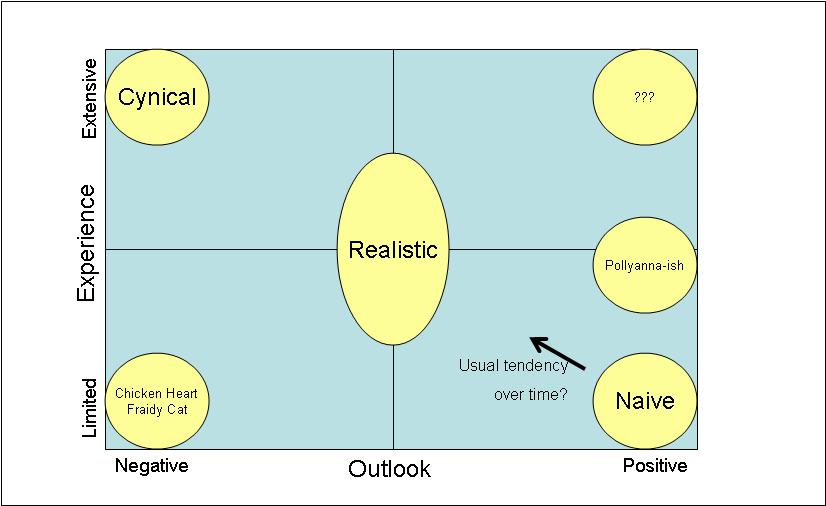
After chewing on this for, well, weeks actually, at some point it clicked for me that there are two dimensions involved: outlook and experience. Most of us start out with a positive outlook and no experience. We're optimistic and idealistic, though someone in our lives may step in to save us from being too gullible. As we grow in experience, we tend to become less positive, even pessimistic, jaded, or cynical over time. It's sad, but some of us actually start out negative and doubtful, and that's definitely a bummer, because I don't think experience will tend to make most people a lot more positive. But let's go back to who makes a difference.
So, going back to the worldchangers: I see them all as positive. But not in a weak way. Instead, I see these folks as being faithful. They had or have faith in humanity's ability to overcome our own weaknesses. And we have people like that still. We have Jimmy Carter, Paul Farmer and Jeffrey Sachs. And hundreds more who are savvy, experience, been through the trenches and yet continue to advocate for positive change. They fit into the upper right of the chart I included. That's where you've got to be if you expect to make positive change!
There are also numerous celebreties, like Bono, Madonna, Angenlina Jolie, etc, who advocate for change, but who may not have the pedigree of experience and who therefore tend to be dismissed as idealists. Funny, isn't it, how a weathered and tested soul can express an opinion and be respected and lauded, but when a young and idealistic person expresses a similar view, they're naive and idealistic? I'm in a similar boat: Older than Angelina, but about the same age as Madonna and Bono, I don't really have much experience in a third world life style, though my mother raised 5 kids solo with the help of AFDC checks. So, if I have positive thoughts about where the world can go, am I a space cadet? Or a visionary?
Who are you?
I believe that each of us can change the world. After all, hundreds of millions of us have changed the world in a small way called "global climate change", so I know that we can have an impact. But who are we?
If you ask me, I say we're visionaries! To hell with the naysayers. Let's work together and, slowly perhaps, change the world for the better. It's our choice, and I'm making mine.
Drop a note. I bet if you've read this far that you've been working on something. Tell us what it's about!
Saturday, November 11, 2006
It's all about the content
I have once again disappeared into the Vortex, this time spending most of my web moments porting an excellent document by Elizabeth Brink of IRN (and AR?) called "Beyond Dams" to (yep) Appropedia.
Beyond Dams talks briefly about the various undesirable impacts of dams, especially large ones, on the ecosystems (including humans) related to rivers. (Tracy Kidder repeatedly mentions such a "bad dam" in Mountains Beyond Mountains. The all time biggy must be China's Three Gorge Dam, which was completed after "Beyond Dams" was written.) The doc goes on to talk extensively about alternatives solutions to many of the problems that have motivated dams in the past. Many of the solutions are very valuable and interesting independent of dams. For example, rainwater harvesting diminishes the need for dams in a couple of ways, but is useful technology even if dams are not in the picture.
Porting this doc has been seriously educational, getting me pointed to a remarkable couple, the Erssons, in Portland. Most of us live lives of such large resource impact ("ecological footprint") that if even a modest fraction of the world lived in the same style we'd all be toast in short order. (Check yours here.) But the Erssons demonstrate that a tiny footprint is achievable in an urban environment, and their achievements are inspirational. I highly recommend that you drop by for a visit. It's a delightful site!
So, anyway, I haven't totally disappeared. But you can tell I'm swamped when I miss an easy opportunity to post about Appropedia's new logo. Check it out; I find it totally cool. It's been up for over a week now, I think, and barely seems newsworthy any more, so only rated this brief mention.
But perhaps I can poke around and get some "web buttons" (or whatever they're called) put together for Appropedia, and we can offer them to other sites (like Resolution) for help with promotion.
Beyond Dams talks briefly about the various undesirable impacts of dams, especially large ones, on the ecosystems (including humans) related to rivers. (Tracy Kidder repeatedly mentions such a "bad dam" in Mountains Beyond Mountains. The all time biggy must be China's Three Gorge Dam, which was completed after "Beyond Dams" was written.) The doc goes on to talk extensively about alternatives solutions to many of the problems that have motivated dams in the past. Many of the solutions are very valuable and interesting independent of dams. For example, rainwater harvesting diminishes the need for dams in a couple of ways, but is useful technology even if dams are not in the picture.
Porting this doc has been seriously educational, getting me pointed to a remarkable couple, the Erssons, in Portland. Most of us live lives of such large resource impact ("ecological footprint") that if even a modest fraction of the world lived in the same style we'd all be toast in short order. (Check yours here.) But the Erssons demonstrate that a tiny footprint is achievable in an urban environment, and their achievements are inspirational. I highly recommend that you drop by for a visit. It's a delightful site!
So, anyway, I haven't totally disappeared. But you can tell I'm swamped when I miss an easy opportunity to post about Appropedia's new logo. Check it out; I find it totally cool. It's been up for over a week now, I think, and barely seems newsworthy any more, so only rated this brief mention.
But perhaps I can poke around and get some "web buttons" (or whatever they're called) put together for Appropedia, and we can offer them to other sites (like Resolution) for help with promotion.
Sunday, November 5, 2006
Grass roots world peace
I've gotten so involved with Appropedia that I sometimes lose track of the bigger picture, why I got engaged in the first place. I'll take this opportunity to remind myself.
My first humanitarian passion, world peace, is not so purely humanitarian as it might seem. It's pretty easy to see the self-interest in world peace; I want to help build a better world for my kids. Sure, I want it for everyone's kids, but since I'm thinking of mine, there is some pretty straightforward self-interest in the neighborhood.
My troubles in trying to get involved with world peace was that much of the focus seemed to be on government and policitical leaders and demonstrations. Not all, of course, but a lot. I wanted to get more personally involved. What can an individual do? How can I live differently in support of world peace? If millions of us take that approach, we will make an impact, and at the same time we will alter the electoral dynamics, which will lead to changes in many of our political leaders. Fifty years ago, political leaders in America didn't discuss environmental issues. Now it is at least a part of the discussion. There is little talk of world peace today, but we can influence whether it is part of the platforms in 20 or 30 or 50 years.
As I dug a little deeper, fortunately, I found more ways to engage in world peace. A key path is education coupled with improving intercultural understanding. Another is the reduction of inequity. Somewhere in this path of discovery I got the "wiki idea" and started my proto wiki, WinWinWiki. A couple of weeks into that effort and I discoved Appropedia and shifted focus to that worthy site.
And there is the circle. Even though Appropedia is more focused on sustainable development (and WinWinWiki was going to aim a bit larger, to include policy discussions and world peace teaching materials, etc), I can still very easily see the connection between the visions of Appropedia folks, and the path to world peace.
It's so great today to see travel sites including humanitarian vacations. Rotary is deeply involved worldwide. Pop stars in various media are raising awareness. But still it's early days. The efforts are diverse and uncoordinated. That's fine, and yet I see some advantages of having a smaller number of sites (dozens instead of thousands?) where people can go to get the information they need. My own investigative efforts were quite frustrating. How many gave up before learning what they were interested in? How many more will engage if they can see how easy it is to get involved?
Thats were infrastructure efforts like Appropedia are aimed. By themselves, they don't do much. But if they help all the other efforts be more effect, and raise awareness in the masses, well then there are ways to improve quality of life for developing countries, and for the children of people, like me, in developed countries as well.
My first humanitarian passion, world peace, is not so purely humanitarian as it might seem. It's pretty easy to see the self-interest in world peace; I want to help build a better world for my kids. Sure, I want it for everyone's kids, but since I'm thinking of mine, there is some pretty straightforward self-interest in the neighborhood.
My troubles in trying to get involved with world peace was that much of the focus seemed to be on government and policitical leaders and demonstrations. Not all, of course, but a lot. I wanted to get more personally involved. What can an individual do? How can I live differently in support of world peace? If millions of us take that approach, we will make an impact, and at the same time we will alter the electoral dynamics, which will lead to changes in many of our political leaders. Fifty years ago, political leaders in America didn't discuss environmental issues. Now it is at least a part of the discussion. There is little talk of world peace today, but we can influence whether it is part of the platforms in 20 or 30 or 50 years.
As I dug a little deeper, fortunately, I found more ways to engage in world peace. A key path is education coupled with improving intercultural understanding. Another is the reduction of inequity. Somewhere in this path of discovery I got the "wiki idea" and started my proto wiki, WinWinWiki. A couple of weeks into that effort and I discoved Appropedia and shifted focus to that worthy site.
And there is the circle. Even though Appropedia is more focused on sustainable development (and WinWinWiki was going to aim a bit larger, to include policy discussions and world peace teaching materials, etc), I can still very easily see the connection between the visions of Appropedia folks, and the path to world peace.
It's so great today to see travel sites including humanitarian vacations. Rotary is deeply involved worldwide. Pop stars in various media are raising awareness. But still it's early days. The efforts are diverse and uncoordinated. That's fine, and yet I see some advantages of having a smaller number of sites (dozens instead of thousands?) where people can go to get the information they need. My own investigative efforts were quite frustrating. How many gave up before learning what they were interested in? How many more will engage if they can see how easy it is to get involved?
Thats were infrastructure efforts like Appropedia are aimed. By themselves, they don't do much. But if they help all the other efforts be more effect, and raise awareness in the masses, well then there are ways to improve quality of life for developing countries, and for the children of people, like me, in developed countries as well.
Thursday, October 26, 2006
Kizingo and Kipungani
Almost 4 years ago, my new wife and I spent our honeymoon in East Africa. As a part of that excellent trip, we stayed a few nights at a resort on the southern shore of Lamu island, off the northern coast of Kenya. The resort has changed names (now Kizingo) and hands, now being owned by the folks that were managing it when we stayed: Mary Jo and Louis Van Aardt. It's a gorgeous and primitive setting! The resort is walking distance from the village of Kipungani, and Mary Jo and Louis support the schools there.
I mention all this because I've gotten the idea that someone could use a wiki (which will go nameless for at least one post) to provide information about all sorts of worthy and ready villages that would like some support in different kinds of projects. Some villages (like Ngelenge) are somehow able to establish their own websites, but I expect that's unusual.
So, I got this idea, but didn't really know how to try it out. I scrounged around the web trying to find Mary Jo and Louis (whose names I had forgotten). Got a bit tricky, since the place had changed hands and names, but there aren't that many primitive resorts on Lamu :-). I dropped an email and Mary Jo "promptly" wrote back. (Promptly means within a couple of days when she had a chance to load her small desktop computer into her small motorboat and put-put-put around the island to Lamu Town where they actually have steady power and a phone connection that will allow her to send and receive email. I'm tellin' ya, the place is primitive. But I don't want to make it too attractive. What's something negative? Hmm. Oh! Okay, here goes: There are no shops! No restaurants! No taxis! Heck, no cars! Generator runs just 2 hours a day! Want a newspaper? Sorry! Anyway, you get the idea...)
The long and short of it is, I have now asked Mary Jo if she might be able to help me connect with Kipungani village and use them as the "guinea pig" for this "host village page" notion that I have.
What will she say? Don't know. We'll have to wait for her next boat trip. Stay tuned!
Louis Van Aardt. It's a gorgeous and primitive setting! The resort is walking distance from the village of Kipungani, and Mary Jo and Louis support the schools there.I mention all this because I've gotten the idea that someone could use a wiki (which will go nameless for at least one post) to provide information about all sorts of worthy and ready villages that would like some support in different kinds of projects. Some villages (like Ngelenge) are somehow able to establish their own websites, but I expect that's unusual.
So, I got this idea, but didn't really know how to try it out. I scrounged around the web trying to find Mary Jo and Louis (whose names I had forgotten). Got a bit tricky, since the place had changed hands and names, but there aren't that many primitive resorts on Lamu :-). I dropped an email and Mary Jo "promptly" wrote back. (Promptly means within a couple of days when she had a chance to load her small desktop computer into her small motorboat and put-put-put around the island to Lamu Town where they actually have steady power and a phone connection that will allow her to send and receive email. I'm tellin' ya, the place is primitive. But I don't want to make it too attractive. What's something negative? Hmm. Oh! Okay, here goes: There are no shops! No restaurants! No taxis! Heck, no cars! Generator runs just 2 hours a day! Want a newspaper? Sorry! Anyway, you get the idea...)
The long and short of it is, I have now asked Mary Jo if she might be able to help me connect with Kipungani village and use them as the "guinea pig" for this "host village page" notion that I have.
What will she say? Don't know. We'll have to wait for her next boat trip. Stay tuned!
Wednesday, October 18, 2006
Confessions of a carbon junkie
AUSTRALIANS NOTE: you can see see An Inconvenient Truth for free. Intrepid Travel's CEO explains why he's picking up the tab:
from Confessions of a carbon junkie, on Crikey. (I recommend the full article - it's not very long.)This year Intrepid will carry 50,000 travellers and on average each will fly about 17,000 kilometres to and from their destination. That’s about 850 million kilometres. If you go to the Climatecare website it also works out to about 135,000 tons of CO2. Youch...
As happens with tipping points, Al Gore’s movie was about to be launched and so went to a preview screening of that. I walked out and thought, “Well, if I do nothing else, at least I can encourage people to see that film. That alone will help to change behaviours and start to make a difference.” So we offered to refund the ticket price if people sent us their movie ticket stubs. So far about 1,500 people have – but I’m hoping a lot more will...
I’m planning for Intrepid to become a carbon neutral travel company in the next three years. Call that an epiphany? No, just common sense and self-interest: if we want people to travel, we have to do something to ensure there is a world worth travelling in.
Tuesday, October 17, 2006
Engineers Without Borders, Unlimited
I just spent several minutes reading the Mission and Vision of EWB-USA. What a remarkable group! Now, I have to acknowledge that there are tons of remarkable groups out there. Still, I'm struck by their approach, captured in this sentence:
What I really like about this is the straightforward acknowledgement of the large eco-system that is involved in making change happen in the third world. EWB's articulate vision helps me to clarify my own vision. I want to help facilitate this eco-system!
What can be done to facilitate? Pardon my geekness, but I'll answer it this way. One kind of facilitation can be achieved through publishing "open API's". (API's are "application programming interfaces".) What I mean is, if each stakeholder, or group of stakeholders, openly announces the ways in which they prefer to connect with or work with the other stakeholders (i.e. "interface"), then the various players can much more easily support one another. Here's my example.
EWB mentions the social scientists group. I take that to include anthropologists, who may be doing regional assessments, like Paul Farmer, the MD/Anthropology PhD, did in Haiti. In an "open API" approach, EWB could proactively say, "If any of you anthropologist groups happen to be performing assessing a region, here's the information that we would really find usefu for determining water supply issues, and here's another set that's very helpful for building schools." Chances are, adding a few items to an assessment is only incrementally more work. Then the village organizations can chip in and gather much of the information in the absence of anthropologists. Another group, like Engineers for a Sustainable World, can say "Here's our list of desired info for planning sanitation projects." Then the economists and health professionals can chime in with reports that help prioritize (the unfortunate reality) of schools with respect to hospitals for a given region. Charitable organizations and NGOs can plan fundraising for different kinds of projects because they have a fair idea of the cost. Social scientists can train for the appropriate translation skills because they know the topics that need to be covered. Pretty soon, Version 2.0 of the API's evolves, and each group gets what they need without having to repeat half of the effort of another group.
With "standardized interfaces", each group can do its job more effectively. The work becomes a little bit "commoditized", which helps, but there is still room for "differentiation", and different approaches. That's cool, because the more, the merrier. A little "healthy competition" keeps us all at the top of our game.
So, thank you, EWB! For supporting the Sustainable Development Open API Version 1.0! I look forward to the first release of the draft standard. And it won't surprise you to hear that I'd like to see the draft published at Appropedia. That's what we're about over there: sharing information.
EWB-USA promotes a new way of thinking for the engineering profession and provides unique opportunities for engineers to work in partnership with a wide range of stakeholders such as communities, social scientists, public health officials, economists, businesses, and international development organizations.
What I really like about this is the straightforward acknowledgement of the large eco-system that is involved in making change happen in the third world. EWB's articulate vision helps me to clarify my own vision. I want to help facilitate this eco-system!
What can be done to facilitate? Pardon my geekness, but I'll answer it this way. One kind of facilitation can be achieved through publishing "open API's". (API's are "application programming interfaces".) What I mean is, if each stakeholder, or group of stakeholders, openly announces the ways in which they prefer to connect with or work with the other stakeholders (i.e. "interface"), then the various players can much more easily support one another. Here's my example.
EWB mentions the social scientists group. I take that to include anthropologists, who may be doing regional assessments, like Paul Farmer, the MD/Anthropology PhD, did in Haiti. In an "open API" approach, EWB could proactively say, "If any of you anthropologist groups happen to be performing assessing a region, here's the information that we would really find usefu for determining water supply issues, and here's another set that's very helpful for building schools." Chances are, adding a few items to an assessment is only incrementally more work. Then the village organizations can chip in and gather much of the information in the absence of anthropologists. Another group, like Engineers for a Sustainable World, can say "Here's our list of desired info for planning sanitation projects." Then the economists and health professionals can chime in with reports that help prioritize (the unfortunate reality) of schools with respect to hospitals for a given region. Charitable organizations and NGOs can plan fundraising for different kinds of projects because they have a fair idea of the cost. Social scientists can train for the appropriate translation skills because they know the topics that need to be covered. Pretty soon, Version 2.0 of the API's evolves, and each group gets what they need without having to repeat half of the effort of another group.
With "standardized interfaces", each group can do its job more effectively. The work becomes a little bit "commoditized", which helps, but there is still room for "differentiation", and different approaches. That's cool, because the more, the merrier. A little "healthy competition" keeps us all at the top of our game.
So, thank you, EWB! For supporting the Sustainable Development Open API Version 1.0! I look forward to the first release of the draft standard. And it won't surprise you to hear that I'd like to see the draft published at Appropedia. That's what we're about over there: sharing information.
Sunday, October 15, 2006
Better than handouts: Doing it for themselves
"It makes me proud to be a Bangladeshi" said an SMS that a friend received from Bangladesh. In case you missed it, Muhammad Yunus and the Grameen Bank have been awarded the 2006 Nobel Peace Prize. Microfinance, as pioneered by Yunus and the Grameen Bank, treats the poor as competent people who can make use of the same services as anyone else, (including credit and savings accounts) and with hard work, can improve their own lot.
That's development as it should be.
That's development as it should be.
Appropedia gains momentum
I'm excited to see the level of activity at Appropedia at the moment - every day when I check the recent changes, there's new pages and more maintenance being done to improve the site.
I'm not able to spend all the time I'd like to, but I also keep coming across stuff I want to put on Appropedia. So I've been trying to focus, and avoid getting into the discussions too much, only contributing where I've got something to add and leaving much of it to other competent contributors. Not easy for a natural-born schmoozer like me. But I'm still keeping an eye on things, and adding material when I can - I just added Human-powered devices and Washing and drying clothes.
I'm very much appreciating the work that Curt, Lonny and others are putting in. It feels so much more active (well, it is much more active) with Curt on board. With more awareness-raising, things will get even better.
I'm not able to spend all the time I'd like to, but I also keep coming across stuff I want to put on Appropedia. So I've been trying to focus, and avoid getting into the discussions too much, only contributing where I've got something to add and leaving much of it to other competent contributors. Not easy for a natural-born schmoozer like me. But I'm still keeping an eye on things, and adding material when I can - I just added Human-powered devices and Washing and drying clothes.
I'm very much appreciating the work that Curt, Lonny and others are putting in. It feels so much more active (well, it is much more active) with Curt on board. With more awareness-raising, things will get even better.
Tuesday, October 10, 2006
How to sign yourself up for a Mission
Well, we've been busy over at Appropedia. So busy (most visibly, we just went live with our new Main Page) that I haven't been doing my homework! So, of course, I'll take it out on you.
Here's my assignment: answer 5 questions as a part of developing a new mission statement for Appropedia. This came up on a discussion page a couple weeks back, and Lonny recruited a friend who knows how to do these things. She came forth with the questions below (which are currently on the "Talk" page of the Mission page linked above). I'll work on answering them here.
First, clear your mind. Now, envision Appropedia 5 years into the future:
What are your highest hopes for Appropedia?
What has changed from the present state?
Here's my assignment: answer 5 questions as a part of developing a new mission statement for Appropedia. This came up on a discussion page a couple weeks back, and Lonny recruited a friend who knows how to do these things. She came forth with the questions below (which are currently on the "Talk" page of the Mission page linked above). I'll work on answering them here.
First, clear your mind. Now, envision Appropedia 5 years into the future:
What are your highest hopes for Appropedia?
- My hopes are not for Appropedia as such. My hopes are for the masses of struggling people. I mean the billions that are living at or near the poverty line, living on a dollar a day. My hopes are that the millions, perhaps tens or even hundreds of millions, of concerned and relatively well off humans, will have the information and tools that they seek, and are able to work together to drive change in other parts of the world, as well as at home. (I am also hopeful for the wealthiest billion, who I believe are at long term risk of losing a home, but that challenge is probably beyond 5 years.)
- I see dozens, hundreds, perhaps thousands of small independent organizations, from volunteer groups to think tanks to large charitable groups to local 3rd world community groups, coming to Appropedia (or "son of Appropedia") to share or get the information they need and to reach other groups that they seek to connect with. Successes will breed successes: here is an effective way to drill a well; over here is a good process for assessing community health needs; this page tells you about the best solar cookers; another page shows how to build school houses out of appropriate local materials in a variety of environments; all of this can be done with less environmental impact to assure that progress is not short term, only to slide back. Common errors are called out to help guide success. Contact information for experienced hands-on experts is available. Volunteers prime themselves by reading articles on the region and type of project. Like-mineded people can connect with others.
What has changed from the present state?
- The biggest change from the present state is that it becomes easier to share the information you have developed, and easier to find the information you need.
- In a 5 year timeframe (2011), the greatest accomplishment will be the demonstration that the Millenium Development Goals are in fact achievable, by 2015 as targeted, through achievements of a massive army of well informed and aligned volunteers, charitable organizations and local community groups.
Monday, October 9, 2006
The Wiki Synergy Project
At the moment, I'm trying to think about key strategic ways to advance the aims of Appropedia, i.e. promoting sustainable development and providing and developing ways to beat poverty. The ultimate aim is not to promote Appropedia, but rather the good things that Appropedia stands for.
One of my concerns is that there's a lot of small groups working on these issues, and they could really benefit by sharing information more effectively. For example, instead of having multiple wikis about sustainability issues, why not focus our effort on just the active one(s)? And let's avoid duplicating our efforts - there's no point in two groups developing the same resource in two different places.
See The Wiki Synergy Project (at WikiIndex) for more info, especially the section on Sustainability, environment, & international development wikis. If you follow the links, you'll see the various wikis on these topics - some of which are active, many of which are not.
One of my concerns is that there's a lot of small groups working on these issues, and they could really benefit by sharing information more effectively. For example, instead of having multiple wikis about sustainability issues, why not focus our effort on just the active one(s)? And let's avoid duplicating our efforts - there's no point in two groups developing the same resource in two different places.
See The Wiki Synergy Project (at WikiIndex) for more info, especially the section on Sustainability, environment, & international development wikis. If you follow the links, you'll see the various wikis on these topics - some of which are active, many of which are not.
Chris here...
Glad to be on board here. I'm fairly new to blogging, and currently pre-occupied with personal stuff, but will post from time to time. Thanks for the welcome - I think you have overstated my language skills, but it's true I am fascinated with language. The only foreign language I speak fluently is Indonesian, but I plan to learn others (and currently learning Tetum, as I'm applying for a volunteer position as an election observer in East Timor).
At busy times like this, I'm glad to be contributing to a wiki like Appropedia. I can contribute in a big or small way, and the contribution stays there for someone else to build on. I can also come back any time and join in again. It's a great technology for collaboration, and for building an information resource.
About my username: If you want to find me on the web, just google Singkong2005 - this is the username I use when contributing to wikis, commenting, asking questions, writing vegetarian recipes or whatever. Feel free to call me Chris, Singkong (Indonesian for cassava) or Singkong2005.
At busy times like this, I'm glad to be contributing to a wiki like Appropedia. I can contribute in a big or small way, and the contribution stays there for someone else to build on. I can also come back any time and join in again. It's a great technology for collaboration, and for building an information resource.
About my username: If you want to find me on the web, just google Singkong2005 - this is the username I use when contributing to wikis, commenting, asking questions, writing vegetarian recipes or whatever. Feel free to call me Chris, Singkong (Indonesian for cassava) or Singkong2005.
Saturday, October 7, 2006
Growing Resolution
Exciting news! Chris Watkins (aka Singkong, aka Singkong2005) has agreed to join the Resolution blog as a co-author!
Woohoo! Let's do the wave!
I've introduced you to Chris before; he is the wiki-savvy water and sanitation engineer from Australia, with serious experience in Indonesia (check out his Wikipedia user profile), who introduced me to Appropedia. We've decided that, despite some potential challenges, collaborating in blogspace was a good way to express our support for other collaborative efforts, including wikis and Open Design concepts in general.
I am very pleased to have Chris on board! There is some potential that, in a positive competitive/collaborative spirit, both of us will post more than we would as solo bloggers. And now you'll benefit by getting two (perhaps closely aligned? perhaps not so?) viewpoints for the price of one! I've asked him to do most of his posting in English but it's fine with me if he uses his other 3 languages now and then. Ach, wohl. Hoffentlich kann ich Deutsch ein bißchen besser als Chris schreiben!
Welcome, Singkong!
(Okay, partner, your turn at bat!)
(Hm. Hope the new kid gets the baseball reference.)
Woohoo! Let's do the wave!
I've introduced you to Chris before; he is the wiki-savvy water and sanitation engineer from Australia, with serious experience in Indonesia (check out his Wikipedia user profile), who introduced me to Appropedia. We've decided that, despite some potential challenges, collaborating in blogspace was a good way to express our support for other collaborative efforts, including wikis and Open Design concepts in general.
I am very pleased to have Chris on board! There is some potential that, in a positive competitive/collaborative spirit, both of us will post more than we would as solo bloggers. And now you'll benefit by getting two (perhaps closely aligned? perhaps not so?) viewpoints for the price of one! I've asked him to do most of his posting in English but it's fine with me if he uses his other 3 languages now and then. Ach, wohl. Hoffentlich kann ich Deutsch ein bißchen besser als Chris schreiben!
Welcome, Singkong!
(Okay, partner, your turn at bat!)
(Hm. Hope the new kid gets the baseball reference.)
Tuesday, October 3, 2006
Appropedia Action
It's (not) been a quiet week in Appropedia, my home town. (What the heck? Okay, Garrison Keillor says something like that about Lake Wobegon.)
We've been pretty active over there, and it's starting to bear fruit. Even without aggressive promotion (fear not, it'll come!), we've gotten some notice in several great spots. Engineers Without Borders International has recognized Appropedia as a Solution of the Month for September, and they've also added the wiki to their list of Comprehensive Appropriate and Sustainable Technologies Databases and placed among their list of 12 phenomenal Useful Tools! Ethan Zuckerman has recognized Appropedia as a "very cool idea" and added a link. And Appropedia got great mention on O2 Nederlands.
Meanwhile, several new contributors have shown up and added content. A lot of house cleaning and yardwork have been furiously going on, improving the usability of the site. We're in the final stages before an "open house". That's my perspective; while we haven't been keeping the doors tightly shut, we haven't sent out a zillion invitations either. Once we've gotten all our ducks in a row and vacuumed under the beds and cleaned the windows, we're gonna put onour Sunday best and have our coming out party. (Okay, yeah, I did mix a few metaphors there, but you get the idea.)
One of the things we've been working on is our mission statement. This is a very useful idea, of course. Most of the people scurrying around and getting stuff done all think pretty much alike, and the mission seems fairly obvious. But it helps to find ways to articulate it, and that's what we're working on now. In addition, this exercise helps us make sure we're thinking as BIG as we can. Some stop by the Appropedia Mission discussion page and help us think big!
Another effort has been to create a more colorful and inviting Main Page. I was perfectly happy with it, until I visited some really nice sites. (One site has a great looking main page, but no activity in the last 30 days. ) We're incorporating some of those great ideas at our test page, and will be going live with that shortly.
So, if you don't get an invitation very soon, it's, um, just that I misplaced your address. Drop me a note or comment! Y'all come! Invite your friends!
See you soon at the wiki.
We've been pretty active over there, and it's starting to bear fruit. Even without aggressive promotion (fear not, it'll come!), we've gotten some notice in several great spots. Engineers Without Borders International has recognized Appropedia as a Solution of the Month for September, and they've also added the wiki to their list of Comprehensive Appropriate and Sustainable Technologies Databases and placed among their list of 12 phenomenal Useful Tools! Ethan Zuckerman has recognized Appropedia as a "very cool idea" and added a link. And Appropedia got great mention on O2 Nederlands.
Meanwhile, several new contributors have shown up and added content. A lot of house cleaning and yardwork have been furiously going on, improving the usability of the site. We're in the final stages before an "open house". That's my perspective; while we haven't been keeping the doors tightly shut, we haven't sent out a zillion invitations either. Once we've gotten all our ducks in a row and vacuumed under the beds and cleaned the windows, we're gonna put onour Sunday best and have our coming out party. (Okay, yeah, I did mix a few metaphors there, but you get the idea.)
One of the things we've been working on is our mission statement. This is a very useful idea, of course. Most of the people scurrying around and getting stuff done all think pretty much alike, and the mission seems fairly obvious. But it helps to find ways to articulate it, and that's what we're working on now. In addition, this exercise helps us make sure we're thinking as BIG as we can. Some stop by the Appropedia Mission discussion page and help us think big!
Another effort has been to create a more colorful and inviting Main Page. I was perfectly happy with it, until I visited some really nice sites. (One site has a great looking main page, but no activity in the last 30 days. ) We're incorporating some of those great ideas at our test page, and will be going live with that shortly.
So, if you don't get an invitation very soon, it's, um, just that I misplaced your address. Drop me a note or comment! Y'all come! Invite your friends!
See you soon at the wiki.
Thursday, September 28, 2006
Hockey stick
Several interesting things have been going on the last two weeks. Appropedia has been moved to a much faster server, due to tremendous efforts of Lonny and others in the community. This has given rise to a fun emotional lift, because of the visible improvement. I've also joined the San Francisco Professionals chapter of Engineers Without Borders, though I have not had a chance to attend a meeting. (EWB-SFP is my closest professional chapter, but about an hour away, making for a challenge on weeknights.) I ordered and got personal cards (yay!) which I'm very happy about; now I can easily connect with people and give them my personal email and the Resolution blog address instead of my business info. Finally came across two great international volunteer sites: World Volunteer Web and UN Volunteers.
One of the cool things about joining EWB-SFP is gaining access to their wiki and learning about their long term project in Ngelenge, Tanzania in collaboration with NGEDEA. From what I know so far, the effort began in 2004 with assessment, and this summer included a multi-week onsite project effort. Much of this is documented on the wiki, which unfortunately requires membership even for viewing.
(I don't yet understand why the wiki is hidden. Membership for editing is common, though Appropedia as chosen the open route. I hope to grok that soon, in part because Appropedia aspires to support any and all interested EWB chapters, and it would be great to see it through the eyes of EWB itself. The privacy of other project partners in the development effort is a factor, which may be addressable.)
I also found the Millenium Indicators chart, which gives an easy-to-read glance at where things stand in various regions in the world.
Somehow the convergence of these events has been very exciting for me. I can see the pieces (EWB, volunteer webs, Appropedia) growing on their own in noticeable ways. The Indicators are not all encouraging, and yet I look at it this way. We are at 2006, roughly 5 years into the MDG effort. 2015 is 9 years off. Awareness of the MDG is building, and the infrastructure, including the volunteer sites, EWB efforts, Appropedia, etc are growing. Progress and results are likely to be much higher in the coming 9 years than in the past 5 years. How steep will the hockey stick be? Well, that's up to us and how well we can coordinate.
All together now!
One of the cool things about joining EWB-SFP is gaining access to their wiki and learning about their long term project in Ngelenge, Tanzania in collaboration with NGEDEA. From what I know so far, the effort began in 2004 with assessment, and this summer included a multi-week onsite project effort. Much of this is documented on the wiki, which unfortunately requires membership even for viewing.
(I don't yet understand why the wiki is hidden. Membership for editing is common, though Appropedia as chosen the open route. I hope to grok that soon, in part because Appropedia aspires to support any and all interested EWB chapters, and it would be great to see it through the eyes of EWB itself. The privacy of other project partners in the development effort is a factor, which may be addressable.)
I also found the Millenium Indicators chart, which gives an easy-to-read glance at where things stand in various regions in the world.
Somehow the convergence of these events has been very exciting for me. I can see the pieces (EWB, volunteer webs, Appropedia) growing on their own in noticeable ways. The Indicators are not all encouraging, and yet I look at it this way. We are at 2006, roughly 5 years into the MDG effort. 2015 is 9 years off. Awareness of the MDG is building, and the infrastructure, including the volunteer sites, EWB efforts, Appropedia, etc are growing. Progress and results are likely to be much higher in the coming 9 years than in the past 5 years. How steep will the hockey stick be? Well, that's up to us and how well we can coordinate.
All together now!
Tuesday, September 19, 2006
Whose job is it anyway?
Well, you know the answer to this one, of course. There's a quiz coming, but you're gonna ace it.
The answer is: it's your mom's job. You were right. That's the answer. Just like when we were kids and there was some problem, the clothes weren't clean or the fridge was empty. "Mom! Fix the problem!" Yep, it's Mom's job. For some folks it might be Dad's job. But between the two of them, Mom and Dad, they better get busy because the world has got some problems and it's high time that those problems were fixed.
Granted, some will be dissatisfied with this answer. For example, some folks have lost their moms and dads; my own mom and dad are both gone. Furthermore, I've got kids. Are they supposed to be pushing this on their mom and dad? Hmm. Okay, here's my position on that: Moms, yes; Dads, no. Clear? Still not satisfied?
Maybe we should assign the problem to politicians. They are, as we know, all powerful and omniscient. Or perhaps it's those other people in other countries who really own the solution. (This is a wee bit disturbing that the industrialized West would consider such a thing.) Better yet, it's the UN's assignment, since they control everything. If only they weren't corrupt. Or it's the big businesses, that's who it is! The Exxons and the Daimlers and the ADMs of the world! Or it's the philanthropists, Bill and Warren, they're in charge and will sort it out.
Sigh. None of these answers are very satisfactory. And we've exhausted all the answers, right?
Well, no, we didn't exhaust the list. And one answer was close: Bill and Warren. That answer is close because those individuals are acting on their own behalf. They are not beholden to anyone else, such as shareholders or electorate or member nations. They can take certain matters into their own hands, and make a difference. Because they believe it is worth some sacrifice on their parts. Sure, they can maybe squeak by on the crumbs that are left over. But which of us are so squeezed that we could not sacrifice some tiny fraction of our time or financial wherewithal to make a difference? As a point of reference, a single percent (1%) of US GDP in 2005 alone would have been over $120B. The actual Official Development Assistance for the US in 2005 was 0.22%, or about $27.5B. That's rather less than Warren Buffett's bulk gift, though that will be spent over time. (It's also bit less than 1/3 of the 0.7% of GNP that each industrialized nation has agreed, more than once, to deliver.)
Now, of course, we can all say, with some fair justification, "hey, we gave at the office!" That is, our taxes, withheld from our take-home pay, is supposed to cover these things! Well, yes, true enough. And it highlights the problems with relying on the government to solve these problems when the voters want other things. Separately, we could also argue that we don't feel like we're getting 1/3 of the problem solved with the 1/3 of 0.7% that we're spending. And that highlights the problem that simply throwing money at the problem doesn't necessarily work. Of course, we're not just "throwing money," are we?
So here is the quiz: Whose job is it?
Here is the answer: Ours.
Alright, here's yoursermon homework:
The answer is: it's your mom's job. You were right. That's the answer. Just like when we were kids and there was some problem, the clothes weren't clean or the fridge was empty. "Mom! Fix the problem!" Yep, it's Mom's job. For some folks it might be Dad's job. But between the two of them, Mom and Dad, they better get busy because the world has got some problems and it's high time that those problems were fixed.
Granted, some will be dissatisfied with this answer. For example, some folks have lost their moms and dads; my own mom and dad are both gone. Furthermore, I've got kids. Are they supposed to be pushing this on their mom and dad? Hmm. Okay, here's my position on that: Moms, yes; Dads, no. Clear? Still not satisfied?
Maybe we should assign the problem to politicians. They are, as we know, all powerful and omniscient. Or perhaps it's those other people in other countries who really own the solution. (This is a wee bit disturbing that the industrialized West would consider such a thing.) Better yet, it's the UN's assignment, since they control everything. If only they weren't corrupt. Or it's the big businesses, that's who it is! The Exxons and the Daimlers and the ADMs of the world! Or it's the philanthropists, Bill and Warren, they're in charge and will sort it out.
Sigh. None of these answers are very satisfactory. And we've exhausted all the answers, right?
Well, no, we didn't exhaust the list. And one answer was close: Bill and Warren. That answer is close because those individuals are acting on their own behalf. They are not beholden to anyone else, such as shareholders or electorate or member nations. They can take certain matters into their own hands, and make a difference. Because they believe it is worth some sacrifice on their parts. Sure, they can maybe squeak by on the crumbs that are left over. But which of us are so squeezed that we could not sacrifice some tiny fraction of our time or financial wherewithal to make a difference? As a point of reference, a single percent (1%) of US GDP in 2005 alone would have been over $120B. The actual Official Development Assistance for the US in 2005 was 0.22%, or about $27.5B. That's rather less than Warren Buffett's bulk gift, though that will be spent over time. (It's also bit less than 1/3 of the 0.7% of GNP that each industrialized nation has agreed, more than once, to deliver.)
Now, of course, we can all say, with some fair justification, "hey, we gave at the office!" That is, our taxes, withheld from our take-home pay, is supposed to cover these things! Well, yes, true enough. And it highlights the problems with relying on the government to solve these problems when the voters want other things. Separately, we could also argue that we don't feel like we're getting 1/3 of the problem solved with the 1/3 of 0.7% that we're spending. And that highlights the problem that simply throwing money at the problem doesn't necessarily work. Of course, we're not just "throwing money," are we?
So here is the quiz: Whose job is it?
Here is the answer: Ours.
Alright, here's your
- Watch Part 2 of Jon Stewart's interview with Bill Clinton;
- Read William Easterly's "The Elusive Quest for Growth";
- Extra credit: Review the Millenium Development Goals and articulate which portions, in your opinion, must be done by governmental agencies, and which portions may be done by private individuals or groups.
- Bonus extra credit: Articulate this overall message more crisply and succinctly!
Saturday, September 16, 2006
Plumbing? Or People? Yes.
I had another great meeting with Della this week. Her efforts at the Institute of Infinite Peace are making good progress, and it was great to learn more about where it's headed and what she and the others involved want to accomplish. I won't steal their thunder by mentioning their plans here, except to say that I believe their first event will be in November.
As I spoke to Della about my interest bridging realized something about the Spirituals and the Engineers (my labels for two important "bridge-able" groups), and it's this: Spirituals focus on helping people change; Engineers think in terms of the physical infrastructure. Bam! Right in the middle of our conversation it struck me (an Engineer of long standing) that fixing the "stuff" won't solve the problems if people don't change their behaviors. It seemed so obvious. I gamely maintained the conversation for several minutes while voices in the back of my head said "It doesn't matter how much infrastructure you build, if everyone behaves the same! Am I'm working on the wrong problem?" "Yes! No! Wait!" I ignored the back of my head for a while.
My external conversation with Della passed through a handful of topics, and came around to the Human Forum coming in December in Puerto Rico. The Forum is managed by the Alliance for a New Humanity, which I think of as mostly Spirituals. I'm planning on attending, in part to "network" with a bunch of positive-minded people, and to practice building bridges (in this case, the human relationship kind, not the physical infrastructure kind). It was a good point in the conversation to check back in with the discussion going on in the back of my head. Good progress had been made.
It's true that changing infrastructure won't solve problems like intolerance, prejudice and tendency for industrialized nations to use unfair trade policies that impact poor nations. It's also true that changing how most people think about what's possible will have a big impact on what is possible. But that's not the whole story either. Here are several additional thoughts.
The upshot: How people think needs to change in order to shift the dynamics toward a global Win-Win. Efforts to improve infrastructure are useful and ultimately necessary activities.
People matter. Infrastructure matter. Both are true. Spirituals are right. And Engineers are right.
How cool is that?
As I spoke to Della about my interest bridging realized something about the Spirituals and the Engineers (my labels for two important "bridge-able" groups), and it's this: Spirituals focus on helping people change; Engineers think in terms of the physical infrastructure. Bam! Right in the middle of our conversation it struck me (an Engineer of long standing) that fixing the "stuff" won't solve the problems if people don't change their behaviors. It seemed so obvious. I gamely maintained the conversation for several minutes while voices in the back of my head said "It doesn't matter how much infrastructure you build, if everyone behaves the same! Am I'm working on the wrong problem?" "Yes! No! Wait!" I ignored the back of my head for a while.
My external conversation with Della passed through a handful of topics, and came around to the Human Forum coming in December in Puerto Rico. The Forum is managed by the Alliance for a New Humanity, which I think of as mostly Spirituals. I'm planning on attending, in part to "network" with a bunch of positive-minded people, and to practice building bridges (in this case, the human relationship kind, not the physical infrastructure kind). It was a good point in the conversation to check back in with the discussion going on in the back of my head. Good progress had been made.
It's true that changing infrastructure won't solve problems like intolerance, prejudice and tendency for industrialized nations to use unfair trade policies that impact poor nations. It's also true that changing how most people think about what's possible will have a big impact on what is possible. But that's not the whole story either. Here are several additional thoughts.
- Changing infrastructure doesn't, in itself, change world dynamics, but it can improve the quality of life for the people that get to use the infrastructure.
- Working on infrastructure construction projects is a great way for one group of people to demonstrate to a second group that they are valued.
- Traveling to project sites in developing countries is a good way for people in the industrialized world to get familiar with lifestyles and challenges (including WTO policies) in other regions. Travelers can share their experiences after returning home to broaden the impact.
- People who are shifting their attitudes about the future may desire to take action. Participating in projects is one way that they can act.
- Improving quality of life and reducing inequity ultimately does involve improving infrastructure.
- Establishing seeds of sustainable infrastructure in developing areas can help a sustainable approach take root. Sustainability leverages technology, often developed in wealthy countries, that allows the developing world to skip past the long path of development through destructive approaches. Taking a short cut to sustainability helps everyone.
The upshot: How people think needs to change in order to shift the dynamics toward a global Win-Win. Efforts to improve infrastructure are useful and ultimately necessary activities.
People matter. Infrastructure matter. Both are true. Spirituals are right. And Engineers are right.
How cool is that?
Tuesday, September 12, 2006
The Appropedia / Omidyar Vortex!
I have just escaped (perhaps only temporarily) from a hybrid wiki / social networking vortex! Many exciting things are going on. Working closely with Chris Watkins, and just met Lonny, both of whom are Wiki-types extraordinaire, working diligently on Appropedia! (Side note: I had begun to refer to Chris and Lonny as "wikians", then learned that "Wikians" is specific to Wikia. That's where I started WinWinWiki, but it's not where Appropedia lives, so the label is inappropriate. But I digress...)
Related news is that, thanks to Chris' suggestion and Lonny's openmindedness, Appropedia has opted to expand its scope to include (most? maybe all?) of the content that I was looking for with WinWinWiki! Yay! So I'll be focusing on that fine effort in two ways. First is to actually make wiki changes myself (I've been quite remiss in that department, kinda like I've been a blog-slacker lately). Second is to snoop around for contributors to Appropedia. The first angle will be useful to create some good framework for new content at Appropedia. The second effort will likely result in more content than I can provide (though I hope contribute there as well).
It was part of my poking around that I came across the Millenium Development Goals Wiki and Mark Grimes. The MDG Wiki is a great concept, exactly what I want to do! Unfortunately, MDG Wiki seems to have stalled a little bit (oh no!), but fortunately we can now replicate the idea at Appropedia (yay!). In addition, finding Mark led me to Omidyar.net, an excellent networking site for entrepreneurial world changers. I joined up promptly and Chris was right behind me. There is a wealth of great people, great ideas and discussions going on there, and I spent a bit of time in that direction. I hope to pull some folks there into the wiki vortex :-)
Another area, which hasn't been quite such a diversion, has been learning about Engineers Without Borders (US site, International site). These folks are doing exactly the kind of projects that Appropedia wants to document for the benefit of other efforts. I signed up with the San Francisco Professionals chapter. Turns out that they have a wiki also :-). I need to learn more, but perhaps there is an opportunity to join forces there as well! And looking into EWB helped me find Water for People, another great organization!
In addition to all this great stuff, my good friend Laura pointed me to Global Volunteers, another organization that may be able to leverage/contribute to wiki such as Appropedia. Or maybe it is Global's affiliate groups, like Amizade, which is Portugese for "friendship."
So, I've been enjoying the Vortex. This one, at least, is a good place.
Oh, and couple of minor notes: I changed this blog template to make for a wider content column. If that is painful for many of you, leave a comment (come on, it's easy!) and I'll make it narrower again. And I am in the process of migrating my preferred email address to gmail. See my profile for the address. The Yahoo address will continue to work, though.
Related news is that, thanks to Chris' suggestion and Lonny's openmindedness, Appropedia has opted to expand its scope to include (most? maybe all?) of the content that I was looking for with WinWinWiki! Yay! So I'll be focusing on that fine effort in two ways. First is to actually make wiki changes myself (I've been quite remiss in that department, kinda like I've been a blog-slacker lately). Second is to snoop around for contributors to Appropedia. The first angle will be useful to create some good framework for new content at Appropedia. The second effort will likely result in more content than I can provide (though I hope contribute there as well).
It was part of my poking around that I came across the Millenium Development Goals Wiki and Mark Grimes. The MDG Wiki is a great concept, exactly what I want to do! Unfortunately, MDG Wiki seems to have stalled a little bit (oh no!), but fortunately we can now replicate the idea at Appropedia (yay!). In addition, finding Mark led me to Omidyar.net, an excellent networking site for entrepreneurial world changers. I joined up promptly and Chris was right behind me. There is a wealth of great people, great ideas and discussions going on there, and I spent a bit of time in that direction. I hope to pull some folks there into the wiki vortex :-)
Another area, which hasn't been quite such a diversion, has been learning about Engineers Without Borders (US site, International site). These folks are doing exactly the kind of projects that Appropedia wants to document for the benefit of other efforts. I signed up with the San Francisco Professionals chapter. Turns out that they have a wiki also :-). I need to learn more, but perhaps there is an opportunity to join forces there as well! And looking into EWB helped me find Water for People, another great organization!
In addition to all this great stuff, my good friend Laura pointed me to Global Volunteers, another organization that may be able to leverage/contribute to wiki such as Appropedia. Or maybe it is Global's affiliate groups, like Amizade, which is Portugese for "friendship."
So, I've been enjoying the Vortex. This one, at least, is a good place.
Oh, and couple of minor notes: I changed this blog template to make for a wider content column. If that is painful for many of you, leave a comment (come on, it's easy!) and I'll make it narrower again. And I am in the process of migrating my preferred email address to gmail. See my profile for the address. The Yahoo address will continue to work, though.
Saturday, September 9, 2006
Time for a Bridge
Wow! Another busy week, and again in a very positive way. First (yeah?), there's the whole real life thing: my much-better half was on a much-needed retreat, so little Drew (yeah, that's him in the picture at right from Father's Day) and I were minding the store. And then there's the day job that expects a certain level of attention.
But passion space is where the real action has been. In several ways, I've been bumping up against this particular aspect of reality: there are at least two big communities of people interested in making World Peace a reality. The two communities that have high profiles in my experience are: the spiritual/awareness/consciousness community, and the project/engineering/technology community. Now, when I say it like that it sounds like there is zero overlap, but that's overstating the case. Still, the two communities seem mostly separate. And that's the problem/opportunity. Because I'm convinced that both crowds are vital to a truly successful peace movement. And that's going to require building a bridge.
I've run into this a several ways. Here's the thing: as my profile suggests, my background (and comfort zone) is in the engineering/project space. This context can help explain my wiki bias. I believe that because that's typically the kind of folks (techie/engineering/project) I see in wiki space. And in the related "Engineers without Borders" space. But when I do blog searches for "world peace" or "better world", I am more likely to encounter social networks like Zaadz and Alliance for a New Humanity. These groups are more communicative, better at linking and connecting with a broad audience, and seem to resonate with a broad community.
Now, the techie/engineering/project group is full of great problem solvers, but they don't tend to be quite as good at inspiration and communication. The spiritual community is more inspirational and great at visioning. They may tackle practical problems, but often this sort of topic is not a core subject of discussions. Consequently, the two groups don't interact that much, and it's a shame.
Just this week, I've had some great connections both ways. I've been connecting with Chris Watkins, a serious Wikian and world-changer. In terms of language style and usage, I put Chris in the engineering/project manager/techie group, and if you follow his link you'll get a sense for what I mean by that style and usage. At the same time, I've also connected with Celine (many thanks to Morgan for that). Celine seems to me to be firmly in the mid-space between the two groups. as you can tell from her highly cross-cultural web site, Peace in Practice.
To cap it off, my wife returned from her retreat with a copy of a very interesting magazine: Ode. This seems like a great example of a bridge. That's a risky place to be from a marketing perspective, since members of each group might be more inclined to read publications that are more in their own space. Ode is going to connect with the intersection (okay, the Math minor is coming out now) of these groups, and that intersection is smaller than either group. I'm likely to sign up and work on learning the language of bridging. Expect a post on that. Please help out with a comment if you're ahead of me on the bridging thing!
This post has been a bit rushed, and I don't feel I've captured the tremendous value I've been getting from my connections with Chris and Celine. But stick with us and it will come through. There are several others (like Della and Paul) who are helping this whole thing come together. One pretty interesting thing is how Australia is disproportionately represented, with Morgan, Celine and Chris all hailing from there (for the moment, anyway...Chris is getting itchy feet).
Check in. Join the fun. I'll do my best to keep posting in real time, but there's a lot of activity in email space as well. Drop a note to me at curt_beckmann at yahoo dot com.
Tuesday, September 5, 2006
Another wiki on the right track!
In scouring the web, I finally discovered Engineers Without Borders recently. Not surprisingly, this is a very project "build it" sort of organization, with national and regional organizations (including, of course, EWB-USA). Again, why does it take so long to find these? Anyway, that discovery was very cool... But while reviewing EWB, I came across Appropedia, which is a wiki for many kinds of solutions (water purification, solar energy, etc) that captures a major piece of what I've been thinking about for WinWinWiki. Translation: now I've got to figure out (again) what gaps exist and how to work toward filling them. What if ANHwiki could be bridged with Appropedia? Is there a "gluewiki" that's needed? Hmmm.
What seems pretty clear is that there is a lot going on! I feel there is a critical mass of people and resources and spiritual readiness coming together. To do what? Well, to create a movement toward worldwide support and sustainability. Once the tipping point is reached, it won't take a willing person (like me) such a lot of work just to connect up with the movement! I can see how various organizations reach out to specific groups (students, other organizations), but the broader population is still rather unaware. That will change soon.
What seems pretty clear is that there is a lot going on! I feel there is a critical mass of people and resources and spiritual readiness coming together. To do what? Well, to create a movement toward worldwide support and sustainability. Once the tipping point is reached, it won't take a willing person (like me) such a lot of work just to connect up with the movement! I can see how various organizations reach out to specific groups (students, other organizations), but the broader population is still rather unaware. That will change soon.
Monday, September 4, 2006
Why does it take so long?
I've been digging around the web fairly diligently for several months, and only just found World Changing. Great stuff! But why does it take so long to tumble to these resources?
If you can't tell that this is going to work its way back to WinWinWiki, then you don't know me very well!
My thinking is that, World Changing, while very broad, is angled a bit more toward sustainability than toward my recent diggings, which are more angled toward World Peace, but there is a bunch of overlap in several areas. That, indeed, is how I finally fell across it, in doing a search for clean water supplies for third world countries.
One of the cool things about World Changing (and other resources, of course) is the ability to get an RSS feed, in order to remain plugged in. Well, that works for the web-engaged among us. Probably includes you, or you'd never be reading my blog.
Anyway, cool site. Tons of content there (or referenced there) which would be appropriate for WinWinWiki (first tag!). The second tag I want to make to WinWinWiki is that a broad well-structured wiki (as WinWinWiki aspires to be) would provide a good linkage between the World Peace and World Changing worlds.
Also: I got some great feedback from Paul about WWW's Main Page. He pointed out how hard it is to find the other pages. I'll make a twiddle there. Thanks, Paul!
If you can't tell that this is going to work its way back to WinWinWiki, then you don't know me very well!
My thinking is that, World Changing, while very broad, is angled a bit more toward sustainability than toward my recent diggings, which are more angled toward World Peace, but there is a bunch of overlap in several areas. That, indeed, is how I finally fell across it, in doing a search for clean water supplies for third world countries.
One of the cool things about World Changing (and other resources, of course) is the ability to get an RSS feed, in order to remain plugged in. Well, that works for the web-engaged among us. Probably includes you, or you'd never be reading my blog.
Anyway, cool site. Tons of content there (or referenced there) which would be appropriate for WinWinWiki (first tag!). The second tag I want to make to WinWinWiki is that a broad well-structured wiki (as WinWinWiki aspires to be) would provide a good linkage between the World Peace and World Changing worlds.
Also: I got some great feedback from Paul about WWW's Main Page. He pointed out how hard it is to find the other pages. I'll make a twiddle there. Thanks, Paul!
Thursday, August 31, 2006
What a great week!
Wow! It's great when stuff just clicks.
First, a bit of background. As you can see on my profile, running is one of my interests. I'm not as passionate about it as some; nevertheless, in the last two and half years I've run 3 marathons and 2 half marathons, and I'm currently signed up for one of each. I run more as a tool for fitness (blood pressure, cholesterol, weight, all that) than for pure love of the activity. Still, I must admit that I like running more than, say, riding a stationary bicycle.
I mention this because I want to make an analogy. Lots of the time when I'm training, it's very routine. It's not bad, but it's nothing to write home about either. Just another day. The same is true about working toward the better world, whether it's blogging or wiki work or reading a book or surfing various relevant web content. Lots of times it's pleasant but not truly thrilling.
And then there are other times, both when running and when working toward my new mission, where it really IS thrilling, and both happened this week! On Sunday morning (having partied at Truls' 40th b-day party on Saturday night), I got up about 5:50 in order to join some friends (I was invited by Juls) at a hilly local running spot. Not usually the recipe for a great workout, but this particular Sunday I was in a different place and had one of my best runs of the past year. Just gotta love that!
Then on Wednesday morning my wife, Nilofer, and I got together for coffee with a woman (we'll call her "Della", just because that's her name) that I had heard was on a mission somewhat parallel to mine. Well, I don't know about you, but sometimes those connections just don't quite work. This time, however, it really did! Della is co-founder and president of the nascent Institute for Infinite Peace, which is current a stealth-mode non-profit start-up. (That combination of hyphenations is meant to be wryly oxymoronic.) The Institute will be stepping out in the next few months, but if you look for a website at this very moment you will come up empty. Hold that thought for a month or two, and you'll get a different answer. Probably get an update here, for that matter, so I know you're going to watch this page. Right?
Once I got a sense for our resonance, poor Della had to endure the pent up gushings and ramblings I had been unconsciously tucking away for several weeks (months?). The good news is that Della is extremely gracious and tolerated my exuberance with good humor. Even better news is that there are probably some real opportunities for collaboration. We are both very much optimists, and will tend to see possibilities everywhere, but I bet a nickel that the possiblities in this case are more than illusions.
Coming directly out of this very auspicious (pardon my unbearable wiki-ness of being) beginning, Della connected me to my (wait for it...) doppelwiki! It turns out that the Alliance for a New Humanity has also had the (truly inspired) notion that a wiki could be the ideal tool for connecting and informing well intentioned world changers! Theirs is called (shocking!) ANHwiki (Ed note: sure I'm biased, but I think WinWinWiki has a weensie edge in coolness of moniker. But what do you think? To vote for your favorite, dial...)
Sorry..., kind of lost it there in "link land". So I went to to ANHwiki and had me a look-see. Turns out they have some need for wiki maintenance folks; I have some desire for some web visibility. I think there's some real potential for a joint effort! That is to say, as far as I'm concerned, there's a great opportunity! Could be that's just me, though (after all, I'm a known optimist), so we'll need to wait and see whether ANH sees it in a similar light. I've dropped them a note. Keep your fingers crossed! Could be a win-win, and wouldn't that be perfect?
So, as you can perhaps tell from my subtly (uh-huh) lighthearted tone, I've been experiencing a slight "pinch-me" feeling all week. If this is what comes from pursuing one's passion, I have to say, I recommend it.
First, a bit of background. As you can see on my profile, running is one of my interests. I'm not as passionate about it as some; nevertheless, in the last two and half years I've run 3 marathons and 2 half marathons, and I'm currently signed up for one of each. I run more as a tool for fitness (blood pressure, cholesterol, weight, all that) than for pure love of the activity. Still, I must admit that I like running more than, say, riding a stationary bicycle.
I mention this because I want to make an analogy. Lots of the time when I'm training, it's very routine. It's not bad, but it's nothing to write home about either. Just another day. The same is true about working toward the better world, whether it's blogging or wiki work or reading a book or surfing various relevant web content. Lots of times it's pleasant but not truly thrilling.
And then there are other times, both when running and when working toward my new mission, where it really IS thrilling, and both happened this week! On Sunday morning (having partied at Truls' 40th b-day party on Saturday night), I got up about 5:50 in order to join some friends (I was invited by Juls) at a hilly local running spot. Not usually the recipe for a great workout, but this particular Sunday I was in a different place and had one of my best runs of the past year. Just gotta love that!
Then on Wednesday morning my wife, Nilofer, and I got together for coffee with a woman (we'll call her "Della", just because that's her name) that I had heard was on a mission somewhat parallel to mine. Well, I don't know about you, but sometimes those connections just don't quite work. This time, however, it really did! Della is co-founder and president of the nascent Institute for Infinite Peace, which is current a stealth-mode non-profit start-up. (That combination of hyphenations is meant to be wryly oxymoronic.) The Institute will be stepping out in the next few months, but if you look for a website at this very moment you will come up empty. Hold that thought for a month or two, and you'll get a different answer. Probably get an update here, for that matter, so I know you're going to watch this page. Right?
Once I got a sense for our resonance, poor Della had to endure the pent up gushings and ramblings I had been unconsciously tucking away for several weeks (months?). The good news is that Della is extremely gracious and tolerated my exuberance with good humor. Even better news is that there are probably some real opportunities for collaboration. We are both very much optimists, and will tend to see possibilities everywhere, but I bet a nickel that the possiblities in this case are more than illusions.
Coming directly out of this very auspicious (pardon my unbearable wiki-ness of being) beginning, Della connected me to my (wait for it...) doppelwiki! It turns out that the Alliance for a New Humanity has also had the (truly inspired) notion that a wiki could be the ideal tool for connecting and informing well intentioned world changers! Theirs is called (shocking!) ANHwiki (Ed note: sure I'm biased, but I think WinWinWiki has a weensie edge in coolness of moniker. But what do you think? To vote for your favorite, dial...)
Sorry..., kind of lost it there in "link land". So I went to to ANHwiki and had me a look-see. Turns out they have some need for wiki maintenance folks; I have some desire for some web visibility. I think there's some real potential for a joint effort! That is to say, as far as I'm concerned, there's a great opportunity! Could be that's just me, though (after all, I'm a known optimist), so we'll need to wait and see whether ANH sees it in a similar light. I've dropped them a note. Keep your fingers crossed! Could be a win-win, and wouldn't that be perfect?
So, as you can perhaps tell from my subtly (uh-huh) lighthearted tone, I've been experiencing a slight "pinch-me" feeling all week. If this is what comes from pursuing one's passion, I have to say, I recommend it.
Tuesday, August 29, 2006
Culture of Peace v. Millenium Development Goals
No, this isn't a remake of Godzilla v. Mothra or the latest Grisham novel. This is a glance at two huge initiatives, both now under the auspices of the UN, though they got there by different paths. The Culture of Peace (there are several apparently authoritative sites, and I've just chosen one) was spawned within UNESCO (though I'm sure the initiative had deeper origins). The Millenium Development Goals originated in other (non-UN) international organizations.
Take a look at how the two large initiatives are broken down:
The Culture of Peace has these eight goals:
It's cool because, difficult as these two big initiatives are, they have a lot of overlap, so it's not like we would necessarily have to choose between them. And certainly it's not like they conflict with each other (that would NOT be cool!).
And just to cheer you up even more (no, you're not dreaming), our pals Bill and Warren have working hard toward #6 on the MDG hit parade. (I told Bill he was doing a good job with his foundation when I bumped into him in July. He said "thanks".)
I just thought you'd like to hear some good news for a change.
And, yes, this all somehow plays into the whole wiki thing.
Take a look at how the two large initiatives are broken down:
The Culture of Peace has these eight goals:
- Foster a culture of peace through education
- Promote sustainable economic and social development
- Promote respect for human rights
- Ensure equality between men and women
- Foster democratic participation
- Advance understanding, tolerance and solidarity
- Support participatory communication and the free flow of information and knowledge
- Promote international peace and security
- Eradicate extreme poverty and hunger
- Achieve universal primary education
- Promote Gender Equality and empower women
- Reduce Child Mortality
- Improve Maternal Health
- Combat HIV/AIDS, malaria and other Diseases
- Ensure environmental sustainability
- Develop a Global Partnership for Development
It's cool because, difficult as these two big initiatives are, they have a lot of overlap, so it's not like we would necessarily have to choose between them. And certainly it's not like they conflict with each other (that would NOT be cool!).
And just to cheer you up even more (no, you're not dreaming), our pals Bill and Warren have working hard toward #6 on the MDG hit parade. (I told Bill he was doing a good job with his foundation when I bumped into him in July. He said "thanks".)
I just thought you'd like to hear some good news for a change.
And, yes, this all somehow plays into the whole wiki thing.
Sunday, August 27, 2006
It's growing!
I'm in the middle of reading Roald Dahl's James and the Giant Peach to my 3-year-old son. That peach gets big really fast! And that's also what's happening with WinWinWiki! The one page wiki has become a 20 or 30 pager. Give it a look and add an idea! If it's easier for you to post a comment here, by all means choose that.
Tuesday, August 22, 2006
WinWinWiki Groundbreaking!
Well, even though my posting has not been as daily as I'd like, it's likely to get even more spotty. Why? Cuz I'm going to be baby sitting a new baby! I've just started WinWinWiki as a mini wiki at the Wikia scratchpad. As you will see, the wiki is not even a full single page yet, but all journeys begin with a single step, and I did not want to delay in getting the community involved.
So, please join in and get your hands dirty!
Somehow my metaphors are getting mixed. But I'm sure you understand :-)
Please add the WinWinWiki to your favorite links, and drop by regularly to add a paragraph or page. Or, if you want to provide some guidance, come back here and post a comment.
So, please join in and get your hands dirty!
Somehow my metaphors are getting mixed. But I'm sure you understand :-)
Please add the WinWinWiki to your favorite links, and drop by regularly to add a paragraph or page. Or, if you want to provide some guidance, come back here and post a comment.
Tuesday, August 15, 2006
Building a Better World, the Wiki Way
Recently, in my Elevator Pitch, I talked about creating a webified version of "Building a Better World for Dummies" (again with apologies to Wiley & Sons), a book which does not (yet) exist. More recently I wrote about foundations for peace. How do those tie together? Glad you asked!
As I mention in my profile, I've reached a point where I'm ready to start working hands-on (in addition to donations) for progress toward a better world. I'm particularly attracted toward making a difference internationally, and yet I'm not currently in position to do my best Paul Farmer imitation and jet off to other countries and get my hands dirty. But I'm convinced that I can make a difference, if I can just figure out how. After all, I seem to make a difference in global climate change, right? I make a difference in the US trade deficit, too. These are unconscious, or at least unintended, impacts. I'd like to adjust my behaviors in small and big ways to have a more intentional impact. What if I buy coffee from a different country? Should I buy shirts made from imported cotton? Wine from Chile? Boycott something? Eco-tourism? Why would these things be good or bad? Do I believe in the reasoning behind the action? In addition to lifestyle tweaks, I want to do small direct projects as well.
So I started working the net trying to find something to engage with, and man what a lot of work that was! (Ever googled "world peace"?) I've found tons of sites, and some are quite intriguing to me. Still, the most interesting ones (like this one to help provide clean water in third world countries) are impractical for me. (Basically, I really want to go and do things in third world countries, but I just can't right now.)
In my searching, I realized that I often don't understand the impact of a particular recommended action. In other cases, I'm given a high level idea, but can't see how to translate it into action. In some cases, there are ideas that I just know have been worked out before, but no real guidance is provided. In other cases, I'd like to figure out how to some how connect with others in my local geography who have similar interests. You know, "enter zip code" kind of thing.
Somewhere during this searching process, scattered randomly across weeks or months, I naturally bought books on Amazon, and read various product reviews, and book lists, etc. I also searched TheSchedule.com for running events in various geographies and timeframes. And I studied various things in Wikipedia, a truly amazing collaborative effort. A glance just now shows that 1,300,000 articles are now included in English alone, essentially all written by volunteers since January 2001. The site infrastructure is maintained by a (relatively) tiny staff. Anyone can edit an article; a "neutral point of view" is always the goal, and there are ways of arbitrating disputes about such things. Just an amazing example of a Tipping Point in terms of technology (wiki), infrastructure, and willing people, including a lot of experts in their fields.
So of course I've walked you down my garden path and you can see where I'm headed. I want a combination of a Wiki that allows everyone to join in and work on articulating what they think would be a way to make the world better. I'd like to see a top down structure that starts very big (World Peace) and carves up the problem in various dimensions. Sequential dependencies (we need this before that), and levels of responsibilities (this will need to be handled by bureaucrats, this can be done by corporations, that can be done by individual citizens). Etc, etc.
When I wrote about foundations for peace, I recognized that many of the areas (building understanding, opening lines of communication, peace education) can readily be translated into actions I and other individuals can take right away, if we can get access to guidance from willing experts.
The "Build a Better World Wiki" (let me know if you've got a cooler name) will help us dig right down to specific actions. For example, it can include a sample outline for a presentation on building peace to present at a place of worship, or a community center. It can be a repository for expertise on providing clean water to 3rd world villages. It can include links to organizations that engage in the work you want to do. Indeed, I see links as a key piece of this wiki, since a lot of good work has already been done by numerous organizations. What's missing is a centralized inclusive "clearinghouse" that can be maintained by the community, which will allow it to be kept authoritative and up to date.
Inclusivity is a key point. The biggest and best known wiki, Wikipedia, strives for a Neutral Point of View (NPOV). This aspect of Wikipedia is a critical factor in making it a credible reference, but there are other options, such as including multiple points of view, as pointed out in this Wikia page. Different volunteers may have differing opinions about various issues (e.g. distribution of condoms), and a good clearinghouse can support multiple views and enable volunteers to understand and connect with those efforts that they align with.
I'm not sure if it's a formal pre-requisite for a wiki, but it seems a good idea to develop some first-pass policies and guidelines, such as what content belongs in the wiki, and what doesn't. I'll post on that (please send suggestions!), then I'll take a swing at a proto-wiki (you know I like prototypes) and you all can join the party! After all, a viable wiki requires a fair-sized community of participants to fly (as mentioned in the Wikia page above).
Related to that, it's time to make some noise about this idea. I'm going to start following the recommendations of the Blogger help page. I surely appreciate recommendations and support from you as well!
As I mention in my profile, I've reached a point where I'm ready to start working hands-on (in addition to donations) for progress toward a better world. I'm particularly attracted toward making a difference internationally, and yet I'm not currently in position to do my best Paul Farmer imitation and jet off to other countries and get my hands dirty. But I'm convinced that I can make a difference, if I can just figure out how. After all, I seem to make a difference in global climate change, right? I make a difference in the US trade deficit, too. These are unconscious, or at least unintended, impacts. I'd like to adjust my behaviors in small and big ways to have a more intentional impact. What if I buy coffee from a different country? Should I buy shirts made from imported cotton? Wine from Chile? Boycott something? Eco-tourism? Why would these things be good or bad? Do I believe in the reasoning behind the action? In addition to lifestyle tweaks, I want to do small direct projects as well.
So I started working the net trying to find something to engage with, and man what a lot of work that was! (Ever googled "world peace"?) I've found tons of sites, and some are quite intriguing to me. Still, the most interesting ones (like this one to help provide clean water in third world countries) are impractical for me. (Basically, I really want to go and do things in third world countries, but I just can't right now.)
In my searching, I realized that I often don't understand the impact of a particular recommended action. In other cases, I'm given a high level idea, but can't see how to translate it into action. In some cases, there are ideas that I just know have been worked out before, but no real guidance is provided. In other cases, I'd like to figure out how to some how connect with others in my local geography who have similar interests. You know, "enter zip code" kind of thing.
Somewhere during this searching process, scattered randomly across weeks or months, I naturally bought books on Amazon, and read various product reviews, and book lists, etc. I also searched TheSchedule.com for running events in various geographies and timeframes. And I studied various things in Wikipedia, a truly amazing collaborative effort. A glance just now shows that 1,300,000 articles are now included in English alone, essentially all written by volunteers since January 2001. The site infrastructure is maintained by a (relatively) tiny staff. Anyone can edit an article; a "neutral point of view" is always the goal, and there are ways of arbitrating disputes about such things. Just an amazing example of a Tipping Point in terms of technology (wiki), infrastructure, and willing people, including a lot of experts in their fields.
So of course I've walked you down my garden path and you can see where I'm headed. I want a combination of a Wiki that allows everyone to join in and work on articulating what they think would be a way to make the world better. I'd like to see a top down structure that starts very big (World Peace) and carves up the problem in various dimensions. Sequential dependencies (we need this before that), and levels of responsibilities (this will need to be handled by bureaucrats, this can be done by corporations, that can be done by individual citizens). Etc, etc.
When I wrote about foundations for peace, I recognized that many of the areas (building understanding, opening lines of communication, peace education) can readily be translated into actions I and other individuals can take right away, if we can get access to guidance from willing experts.
The "Build a Better World Wiki" (let me know if you've got a cooler name) will help us dig right down to specific actions. For example, it can include a sample outline for a presentation on building peace to present at a place of worship, or a community center. It can be a repository for expertise on providing clean water to 3rd world villages. It can include links to organizations that engage in the work you want to do. Indeed, I see links as a key piece of this wiki, since a lot of good work has already been done by numerous organizations. What's missing is a centralized inclusive "clearinghouse" that can be maintained by the community, which will allow it to be kept authoritative and up to date.
Inclusivity is a key point. The biggest and best known wiki, Wikipedia, strives for a Neutral Point of View (NPOV). This aspect of Wikipedia is a critical factor in making it a credible reference, but there are other options, such as including multiple points of view, as pointed out in this Wikia page. Different volunteers may have differing opinions about various issues (e.g. distribution of condoms), and a good clearinghouse can support multiple views and enable volunteers to understand and connect with those efforts that they align with.
I'm not sure if it's a formal pre-requisite for a wiki, but it seems a good idea to develop some first-pass policies and guidelines, such as what content belongs in the wiki, and what doesn't. I'll post on that (please send suggestions!), then I'll take a swing at a proto-wiki (you know I like prototypes) and you all can join the party! After all, a viable wiki requires a fair-sized community of participants to fly (as mentioned in the Wikia page above).
Related to that, it's time to make some noise about this idea. I'm going to start following the recommendations of the Blogger help page. I surely appreciate recommendations and support from you as well!
Friday, August 11, 2006
Rolling Up Our Sleeves on Peace
In my recently posted Elevator Pitch, I mentioned the idea of a wiki to build a framework of articulated thoughts that I believe would be useful in aligning and motivating interested parties, and helping to lead toward coordinated action. To give you a taste of what I had in mind, I've captured the following 8 foundations for peace. These come from David Adams' site, Toward a Global Culture of Peace. David Adams was a key director at UNESCO, so as you might expect, other UNESCO references include substantially similar lists.
- understanding, tolerance & solidarity, instead of enemy images
- disarmament, universal & verifiable, instead of armaments
- democratic participation, instead of authoritarian governance
- the free flow & sharing of information, instead of secrecy and propaganda
- dialogue, negotiation, rule of law, active non-violence, instead of violence
- equality of women, instead of male domination
- education for peace, instead of education for war
- economies of peace with equitable, sustainable development, instead of exploitation of the weak and of the environment
This is an excellent list. I want to live in a world like that. On David's site, he mentions that this list may seem Utopian. It can certainly seem very challenging. Nevertheless, I approach with a practical mind and say, okay, is there a way to break these down, prioritize them, sequence them, etc, so that the list seems more manageable? My approach here is partly Project Manager, partly comparative history. I want to figure out what to tackle first, try to figure out inter-dependencies of the items, etc.
Item 1: Understanding, tolerance & solidarity, instead of enemy images
Certainly understanding and tolerance are required at some level to allow coexistence. The two seem "co-dependent"; understanding supports the development of tolerance, and tolerance is an aid to understanding (intolerance is an obstacle to understanding). Solidarity seems pretty important for enduring peace, but it also seems like quite a reach for parties in conflict. So, start with tolerance and understanding and build toward solidarity over time.
Item 2: Disarmament, universal & verifiable, instead of armaments
Disarmament seems similar to "solidarity" above. Hard to achieve in the immediate aftermath of conflict. In addition, I think there are nations with arms are "relatively" peaceful. (Here's where the wiki could come in very handy as experts could chime in.) Also, many ordinarily peaceful objects can be used as weapons (such as commercial airliners). So it seems to me that this is a secondary or tertiary step that can also be deconstructed into separate stages. That is, first achieve a situation of at least short-term stable non-violence, then work to reduce the WMDs and attack-oriented ("offensive") weapons, then eliminate them. If there are such things as a purely defensive weapons (would they be called weapons?), potentially they would not need to be eliminated. Weapons reductions programs have made progress in the past, and they can be successful in the future, though some other items here are probably prerequisites to successful disarmament.
Item 3: Democratic participation, instead of authoritarian governance
Maybe I'm biased, but I'll agree that democracy is a key part of a culture of peace. Questions: do we mean "true democracy" or is "Potemkin democracy" enough? Multiparty elections with freedom of expression? Is Russia a democracy today? Good wiki topics. Though there are some examples of relatively stable, relatively non-aggressive authoritarian nations, they don't seem sustainable. Typically the "benevolent (?) dictator" passes from power, and the suppressed animosity between different factions erupts into civil war. (E.g. Tito and Yugoslavia; note that the article's neutrality is disputed. In my view this is a cool feature of Wikipedia.) Despite democracy's key roll, civil wars typically must be stopped in order to enable the development of democracy. Some kind of stability is a prerequisite for democracy as well as, say, disarmament. Note: this item is apparently referring to governance at a national level, whereas other items in this list can apply across national borders.
Item 4: The free flow & sharing of information, instead of secrecy and propaganda
Openness and transparency are part and parcel of a true democracy. (If we assume that Item 3 refers to "true democracy" then this item seems redundant.) As a side note, Information Theories about the Causes of War view incomplete information across lines of opposing forces as a factor leading to war (I think about WMDs and uranium enrichment in this context). So, sure, free flowing information is important, is a corequesite of Item 3 and very supportive of Item 1.
Item 5: Dialogue, negotiation, rule of law, active non-violence, instead of violence
This is a monster item that is really the core of a culture of peace, and the other items are supporting this. Indeed, if you could somehow achieve this item sustainably without some of the other items, then presumably those other items would not be truly required. This item is big enough to be multiple items, and it could be broken down in a wiki. There is also room for more clarification as to what is meant here. For example, is the "rule of law" within a nation considered part of true democracy? If so, then this may address "rule of law" between nations... Under what auspices? Dialogue and negotiation probably apply both within and across national boundaries; I'll accept them as vital to culture of peace. I see some work to be done defining "active non-violence". Yep, big item, this.
Okay, so let's deconstruct it. Dialogue is primary; it's similar to Item 4, but is interactive between parties. Negotiation seems nearly primary, but there is some complexity around the legitimacy of representation. That is, who negotiates with whom? Does the governance factor comes into play here? Is elected representation (and therefore democracy) required to enable negotiation? Historically, some parties have insisted on dealing with a democratically elected representative, but this has not been universal. So negotiation has some complexity; I'll just leave it at that for now. Further consideration is also required for "active non-violence". As a start, I'll assume it means peacekeeping, peacemaking and peacebuilding.
Item 6: equality of women, instead of male domination
UNESCO has research support the idea that equality of women contributes to a culture of peace. However, some relatively peaceful countries have not achieved full equality (indeed, where has equality been fully achieved?), so I would say that the question of equality is a matter of degree. I hope at least that full equality is not a prerequisite for establishment of peace. In any case, equal rights for women is a desirable component of a culture of peace. The sooner it can be achieved, the better; it can be addressed in parallel with other items.
Curiously, this item (equality of women) raises questions about class, religion, etc. Are these civil rights questions not explicitly referenced in order to avoid contentious debate within UNESCO or with member nations? Perhaps, but I don't see women's equality as less contentious, and I expect racial and religious rights as important to avoiding violence. Wouldn't a true culture of peace include civil rights of those kinds? Clearly some wiki opportunities here.
Item 7: education for peace, instead of education for war
I see this as the most under-invested area. In his book "I'd Rather Teach Peace", Colman McCarthy references the four A's related to the stages of learning a subject: Awareness, Acceptance, Absorption and Action. My sense is that 90+% of the US population has not yet gotten to Acceptance, and perhaps 50% are not even at Awareness yet. Is this true? If so, why? Is it something about human nature? Or is it lack of exposure? Some opportunity for wiki discussion here, of course.
Understanding how peace works, what it depends on and how it benefits everyone is as important as Algebra, which is taught in every high school, but what high school has an established peace curriculum? This item offers some great wiki opportunities as well. I'd like to see a collection of peace education options, such as seminars for places of worship, after-school seminars at various levels (both of which could presumably be led by someone without a teaching credential), community college courses, etc, along with links to organizations that might connect you with a qualified teacher. There can be links to sites with suggested outlines, sample curricula, and success stories. Eventually, I'd like to see some tools that help interested people in a particular zip code find each other so that they can join forces to promote / develop peace education options in their area.
Item 8: economies of peace with equitable, sustainable development, instead of exploitation of the weak and of the environment
Sustainability is a long term concept, in a couple of senses. It is necessary to make peace work in the long term. It will also require work over the long term to achieve! It is very interconnected with peace. Absence of peace has nasty implications for sustainability. Absence of sustainability has nasty implications for peace. This area is co-requisite of peace. One concern I have here is that a peace movement that is too aggressively green may be perceived as outside the mainstream and may hamper acceptance of the larger peace effort. So my bias is to support green policies through reasoned argument but resist the hard core rhetoric. Here, again, is a great opportunity for wiki input. Ideally we can accommodate and discuss a wide spectrum of thought here, and individuals can invest where they believe there is maximum impact.
This item also references "economies of peace"; it brings to mind Eisenhower's Military Industrial Complex on the one hand. For Wilsonians like Michael Mandelbaum, peace and democracy are linked to a third leg: free markets. But that's not referenced here. Plenty of fodder in this item for discussion. Certainly the structure of an economy can either aid or provide obstacles to effective and equitable distribution of resources, and therefore impact a culture of peace.
I hope this loonngg post provides some ideas for the wiki-aware as to how a constructive interaction can be built around a culture of peace, in addition to translating the 8 chunky items into actionable steps. I'd like to develop similar, probably separate but presumably linked, cooperative discussions and actionable steps around world health, third world development, sustainability, human rights, and any other area ripe for progress.
I've done some poking around for good wiki hosting sites. I'd welcome any suggestions in this area.
Lame? Intriguing? Redundant? Unclear? As always, I'm eager to know what you think, so be bold and offer a comment!
Loved this book!
My daughter gave me Tracy Kidder's Mountains Beyond Mountains, which is mostly about the early work and life of Paul Farmer. (I say "early" because Dr Farmer is slightly younger than I am, which means, of course, that he's still just a young man with lots left to do.) I finally picked the book up about a week ago and could hardly put it down. I've seen references to Paul Farmer in other blogs, so I expect some of you have read the book, but for those that haven't, it's a treat that shouldn't be missed!
Because Farmer is currently active and the context is recent current events, the narrative is very easy to connect with. In addition, Farmer is simultaneously both very human and peerless. A top medical expert in infectious disease, an accomplished anthropologist, a workaholic, a passionate and articulate visionary, a humanitarian, in short, a modern-day Albert Schweitzer, if not so religiously oriented. But fear not; this is not 330 pages of unadulterated praise for an idealized icon. We learn about how the world works in specific ways around providing health services to the very poor. We learn about the difficulty of accomplishing large scale programs on the tight budgets that are reality at the WHO. We learn how programs must be constrained in order to garner support, but how these constraints can have very deleterious, counter-productive effects. We learn about the economics and incentives around the manufacturing and pricing of second line drugs. We also learn about numerous other remarkable people besides Farmer. And, yes, we see some of Farmer's warts, too. We see that, despite so much bad news that we hear, there really are remarkable successes that can encourage us. We are inspired, yes, but also wiser.
Better than fiction; better than historical biography. This is my new favorite book.
If you're not a reader (well, okay, if you're not a book reader), then take a peek at the organization that he cofounded and which supports his work and the work of others: Partners in Health. And of course, there's a Wikipedia page on Farmer as well, but if you're like me you'll enjoy the book more if you haven't read the article first.
Because Farmer is currently active and the context is recent current events, the narrative is very easy to connect with. In addition, Farmer is simultaneously both very human and peerless. A top medical expert in infectious disease, an accomplished anthropologist, a workaholic, a passionate and articulate visionary, a humanitarian, in short, a modern-day Albert Schweitzer, if not so religiously oriented. But fear not; this is not 330 pages of unadulterated praise for an idealized icon. We learn about how the world works in specific ways around providing health services to the very poor. We learn about the difficulty of accomplishing large scale programs on the tight budgets that are reality at the WHO. We learn how programs must be constrained in order to garner support, but how these constraints can have very deleterious, counter-productive effects. We learn about the economics and incentives around the manufacturing and pricing of second line drugs. We also learn about numerous other remarkable people besides Farmer. And, yes, we see some of Farmer's warts, too. We see that, despite so much bad news that we hear, there really are remarkable successes that can encourage us. We are inspired, yes, but also wiser.
Better than fiction; better than historical biography. This is my new favorite book.
If you're not a reader (well, okay, if you're not a book reader), then take a peek at the organization that he cofounded and which supports his work and the work of others: Partners in Health. And of course, there's a Wikipedia page on Farmer as well, but if you're like me you'll enjoy the book more if you haven't read the article first.
Monday, July 31, 2006
Elevator pitch
It's (past?) time I worked out my elevator pitch for this project. The blog description above (essentially the blog's subtitle: "It is my conviction...") is close, but really just tells you (the "venture capitalist" in our story) where I'm coming from, and not what I'm asking you to invest in. You may have read that I favor prototypes. Here is my prototype for an elevator pitch (understand that I'm racing to paint a picture here before the elevator stops, the door opens and you exit for your board meeting):
The stream of conscious that got me here was roughly:
Things are broken! Who is responsible for making the world better, anyway? Elected officials? Business leaders? People in other countries? Religious leaders? I've got it! The UN! Well, okay, so nobody's in charge. If so, we're doomed to solve only those problems that reach the level of crisis in first world countries. 2nd and 3rd world country problems will be dealt with on a "best effort" basis, i.e. "we'll get to it when we can." Maybe I should just quit...
No, something's not right. Aha! Here's the flaw! Turns out, I can be responsible. (Took a while to buy that.) So, how can I get involved? What can I do? A short bit of looking and I'll find 10 opportunites to make a difference! But not so easy. Lots of good sites (took a while to find, topic for another post) but most don't really help a willing soul connect with hands-on work.
For example, here's one of the better sites I've come across, in the sense that it has full page of things to do. But it's a challenge to use this site to reach out and engage. Many items I'm already doing, others imply a separate organization (but no tools to find such), and still others seem to lack credibility ("Cultivate a spirit of generosity by giving whole-heartedly of your time, expertise, and resources": does that actually work?) and another group seems way overwhelming for an individual ("Facilitate concerted action among non-governmental organizations on complex issues").
Part of the challenge was (and still is?) my own, uh, is it laziness? I've gotten spoiled by other coordinated web sites that walk you down a path. Like those sites that help you to customize a car, then link you to the nearest dealer, and The Schedule, that helps me find running events by location and date, and Amazon, that suggests similar products and provides customer reviews.
Well, at this point this post has taken me several hours (over several days) to write (and maybe it wasn't the most fun to read either). So I'm going to take a swing at the revised version and see what you think. Got your VC hat on again?
So...would you invest in this? By investment, I mean spend some time thinking about it, provide feedback on the concept as well as input into the wikis as they develop. If not, why not? As with entrepreneurs and their elevator pitches, if this one doesn't work, I want to evolve the concept and the pitch to something that resonates. I believe there is something worth pursuing in this "market segment".
Thank you for your time. Let's keep in touch. And here's where you say "We'll call you..."
I want to help other people the way that I myself have wanted to beOkay, so that was not really satisfactory as an elevator pitch. But before I try to "rev" the prototype, I want to finish my thought. Please set aside your VC persona for a mo'.
helped. I recently spent some time seeking to join with others in
campaigns to work on driving positive change in the world.
Writing a check is one way to get involved, and I'd done some of that, but I was
looking for the next step. Trouble is, it's actually pretty tricky to find
compatible involvement. Peace corps, peace studies programs, political
demonstrations, etc, those are pretty easy to find. But everything I
found was either impractical or unsatisfactory. As a result, I... Oh, this is
your floor? Well, anyway, um, maybe next time I, uh, can fill you in a bit more...
Hmm. Just noticed a problem: I feel compelled to "tell my story", but my story is too long for an elevator pitch. Maybe if I get it (my story) off my chest I'll be able to set it aside and create a crisp pitch. Bear with me a moment. What the heck, I'm 80% there anyway...Yeah, so where was I? Oh, right. If you add up all the hands on, work-oriented
activities that are readily found on the web, there are a few thousand people
doing those things. If you look at the number of people who have
volunteered in the US, and who might be willing to do some work-oriented
activity, you get a number more like 50 million! No way they can all join the
peace corps, but getting, say, 30 minutes a week from that many people can make
a larger impact than all the full-timers. And it wouldn't replace ongoing work;
it would be in addition to the impact that is already being made. There,
that's my point. Whaddaya think?Wait, there's more! I'm one of those willing folks, but as a willing person I spent a fair bit of time trying to find the kinds of activities that 1) fit my skill set, 2) fit my schedule, 3) fit my passion profile (I just made that phrase up, but I think you know what I mean) and 4) fit my geography. [I just recently found VolunteerMatch...maybe that's the ticket for coordinated projects? But not for free form]
The stream of conscious that got me here was roughly:
Things are broken! Who is responsible for making the world better, anyway? Elected officials? Business leaders? People in other countries? Religious leaders? I've got it! The UN! Well, okay, so nobody's in charge. If so, we're doomed to solve only those problems that reach the level of crisis in first world countries. 2nd and 3rd world country problems will be dealt with on a "best effort" basis, i.e. "we'll get to it when we can." Maybe I should just quit...
No, something's not right. Aha! Here's the flaw! Turns out, I can be responsible. (Took a while to buy that.) So, how can I get involved? What can I do? A short bit of looking and I'll find 10 opportunites to make a difference! But not so easy. Lots of good sites (took a while to find, topic for another post) but most don't really help a willing soul connect with hands-on work.
For example, here's one of the better sites I've come across, in the sense that it has full page of things to do. But it's a challenge to use this site to reach out and engage. Many items I'm already doing, others imply a separate organization (but no tools to find such), and still others seem to lack credibility ("Cultivate a spirit of generosity by giving whole-heartedly of your time, expertise, and resources": does that actually work?) and another group seems way overwhelming for an individual ("Facilitate concerted action among non-governmental organizations on complex issues").
Part of the challenge was (and still is?) my own, uh, is it laziness? I've gotten spoiled by other coordinated web sites that walk you down a path. Like those sites that help you to customize a car, then link you to the nearest dealer, and The Schedule, that helps me find running events by location and date, and Amazon, that suggests similar products and provides customer reviews.
Well, at this point this post has taken me several hours (over several days) to write (and maybe it wasn't the most fun to read either). So I'm going to take a swing at the revised version and see what you think. Got your VC hat on again?
We are going to create a fully-webified version of "Building a Better World
for Dummies" [apologies to Jon Wiley &
Sons]. Self-assessment tools and matching tools, an event schedule and
search tools for organizations and events. There'll be a wiki so everyone can
participate (we want broad engagement!) in defining a full set of views on
areas where improvement is needed, steps for implementing it, and the logic
and philosophy behind it. There'll be wiki articles to show
both why progress is urgent and reasons why it can and will be achieved.
In short, we're going to create an online infrastructure to support the work of
an army of doers working for a better world.
So...would you invest in this? By investment, I mean spend some time thinking about it, provide feedback on the concept as well as input into the wikis as they develop. If not, why not? As with entrepreneurs and their elevator pitches, if this one doesn't work, I want to evolve the concept and the pitch to something that resonates. I believe there is something worth pursuing in this "market segment".
Thank you for your time. Let's keep in touch. And here's where you say "We'll call you..."
Subscribe to:
Comments (Atom)